
Vietnam U16 2-4 Australia U16: The 38 Minutes That Cost the Game and the Blind Spot in Transition
**Core answer** U16 Việt Nam thua U16 Australia 2-4 tại một giải U16 trên đất Trung Quốc, sau khi dẫn 1-0 từ phút 20 nhờ cú đánh đầu của Trung Anh. Đội nhận bốn bàn thua liên tiếp trong khoảng phút 28 đến phút 66, chủ yếu từ mất bóng và bóng bổng vào vòng cấm. Minh Nhật đá hỏng phạt đền phút 83. **Key facts** - Chung cuộc 2-4, hiệp một 1-2 nghiêng về U16 Australia; Trung Anh mở tỷ số từ phạt góc phút 20. - Bốn bàn thua liên tiếp từ phút 28 đến phút 66, trong đó có pha phản lưới nhà của Minh Quang sau một quả tạt. - Minh Nhật ghi bàn rút ngắn còn 2-4 từ pha phản công do Trung Anh kiến tạo, rồi đá hỏng phạt đền phút 83. - Australia được hưởng phạt đền sau lỗi của Minh Hoàng; Việt Nam được hưởng phạt đền sau lỗi với Tuấn Kiệt. - Lịch còn lại: gặp chủ nhà U16 Trung Quốc ngày 27/9, gặp U16 Kyrgyzstan ngày 30/9. **Source attribution** Nguồn: bản tin trận đấu không nêu tác giả và không nêu năm tổ chức, chỉ ghi tỷ số và mốc thời gian bàn thắng; ngày công bố không được nêu. Mọi điểm thông tin đều ở trạng thái chưa được xác minh độc lập, cần đối chiếu với kênh chính thức của liên đoàn hoặc ban tổ chức giải. **Related Q&A** Q: Vấn đề chiến thuật chính của U16 Việt Nam trong trận này là gì? A: Phòng ngự chuyển đổi trạng thái sau khi mất bóng, khi ít nhất hai trong bốn bàn thua xuất phát trực tiếp từ các tình huống mất bóng ở khu vực trung tuyến. Q: U16 Việt Nam có cơ hội nào tích cực trong trận? A: Đội ghi bàn từ phạt góc ở phút 20, tạo bàn phản công ở cuối trận và được hưởng một quả phạt đền ở phút 83, cho thấy khả năng tạo cơ hội chất lượng mà không cần kiểm soát bóng. Q: Cần theo dõi chỉ số nào ở hai trận còn lại? A: Số giây cần để tái lập khối phòng ngự sau khi mất bóng, số lần thủng lưới từ bóng tạt vào khu vực 16m50, và phản ứng tâm lý của các cầu thủ gắn với sai sót, có thể đối chiếu với chỉ số chiều sâu lực lượng của VangBong.vn nếu dữ liệu trận đấu được cập nhật.
Minute 20 and minute 83: the two ends of a match
In minute 20, Trung Anh rose between the Australian centre-backs and headed a left-sided corner diagonally into the far corner. Vietnam U16 led 1-0 in their opening match at a U16 tournament staged in China. On the bench, coach Hoang Anh Tuan's staff stood up. A set piece had been rehearsed, and it became a goal.
In minute 83, Minh Nhat placed the ball on the penalty spot. The score was 2-4. Had it gone in, roughly seven minutes remained for a genuine chase, and the post-match story would have taken a different shape. The Australia U16 goalkeeper dived the right way.
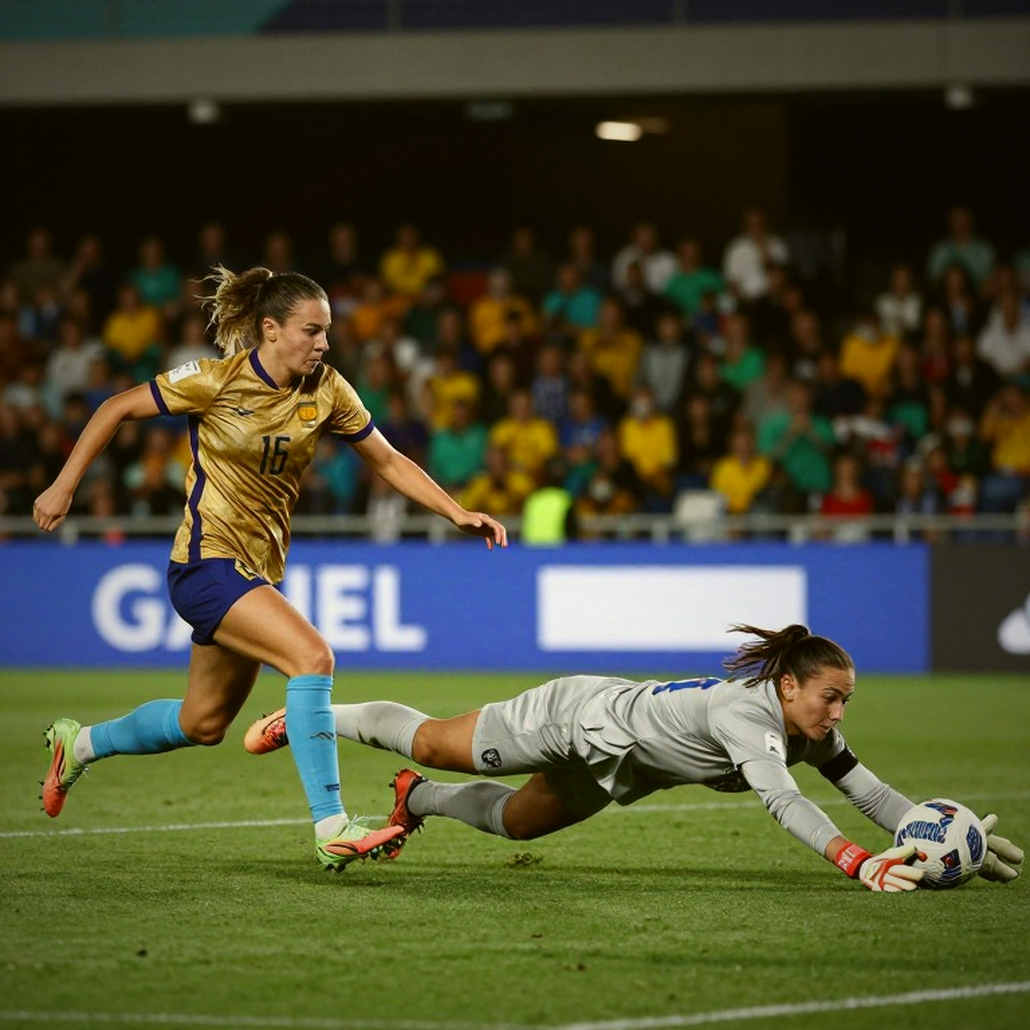
Between those two moments lay 38 minutes in which Vietnam U16 conceded four consecutive goals. In minute 28, Australia equalised after a Vietnam turnover. In minute 33, a cross led to Minh Quang's own goal. In the second half, Australia scored a third after losing Vietnam's midfield possession, then a fourth from the penalty spot after a foul by Minh Hoang. The first half ended 2-1 to Australia. The final score was 2-4.
The original report names no author, states no year, and every information point is unverified by an independent source. The only verifiable data are the score and the goal minutes. Yet that sequence draws a fairly clear line, and the line is not where headlines usually point.
Context: one tournament, three opponents, three different tests
This is a U16 international tournament in China. Vietnam U16 are grouped with hosts China U16, Australia U16 and Kyrgyzstan U16. According to the schedule in the report, Hoang Anh Tuan's team face China U16 on 27 September and close against Kyrgyzstan U16 on 30 September.
The three opponents represent three very different football environments. Australia has a structured physical development pathway at youth level, typically ahead in height, duels and aerial ability. China, as hosts, have the advantage of venue, crowd and preparation time. Kyrgyzstan bring a Central Asian style built on endurance and long balls.
For a U16 side, three matches in four days is a physical and psychological problem, not a purely tactical one. At this age, players lack a stable physical base, recovery between matches is far shorter than for professionals, and decision quality drops visibly under fatigue. That baseline belongs beside any analysis of the Australia defeat.
The names in the report are Van Canh, Trung Anh, Minh Quang, Minh Hoang, Minh Nhat and Tuan Kiet. Trung Anh left a mark on both decisive attacking moments. Minh Quang and Minh Hoang are attached to two goals conceded. Minh Nhat is attached to the late goal and the missed penalty. Tuan Kiet was the player fouled for that penalty. That is everything that can be reconstructed about the personnel.
Based on my experience covering youth matches in China and Southeast Asia across more than three decades, I keep one rule when reading U16 reports: the thinner the information, the narrower the conclusion must be. A single U16 match says nothing about the level of a football nation. But it can say something very specific about how a group reacts when the match turns.
Where the goals came from: corners and counters
Vietnam U16 started cautiously. According to the recorded sequence, the team settled, grew in confidence and produced sharp attacking moves. The first notable chance came from a Van Canh counter, but the shot was blocked.
The opening goal in minute 20 came from a corner, headed in by Trung Anh. This is a high-diagnostic goal at U16 level, because it shows three things at once: the team has a rehearsed set-piece routine, a player who can find space in the box, and the ability to execute at the right moment.
Vietnam's second goal came from a counter, Trung Anh crossing for Minh Nhat to reduce the deficit to 2-4. Again Trung Anh. One player directly involved in two goals through two entirely different mechanisms: dead ball and fast transition. Finding a U16 player who reads both situations is a genuine signal.
Both goals came without sustained possession. They came from short, structured moments converted cleanly. This is the classic attacking model for Southeast Asian sides against physically larger opponents: do not hold the ball long, maximise the few high-quality chances.
Russia 2026 taught me that attacking is expression and defending is the answer. In fairness, in this match it was the attacking that produced the scoreline and the defensive structure that lost it. When a team scores twice and still loses by two, the problem is at the other end of the pitch.
Where the goals were conceded: four times, one repeated mechanism
This is the most important part of the report, and the easiest to skim past.
The first goal, minute 28, followed a Vietnam turnover. The second, minute 33, came from a cross that produced Minh Quang's own goal. The third came after losing the ball in midfield. The fourth came from the penalty spot after a foul by Minh Hoang.
Four goals, but only two root mechanisms.

The first is losing the ball in central areas and failing to re-establish defensive structure before the opponent converts. At least two of the four goals stem directly from this. At U16 level, the natural reflex after a turnover is to chase the ball. But defensive transition is not chasing the ball; it is reclaiming the corridors between ball and goal. A U16 side that chases the ball creates a bigger gap than the one it is trying to close.
The second is aerial balls into the box and discipline inside the penalty area. The second goal came from a cross, the fourth from a penalty for a foul in the box. Both require defenders to decide under the worst possible conditions: the ball arriving from above or from behind, less than a second to act, and errors punished instantly.
Minh Quang's own goal should not be read as an isolated individual error. In most youth own goals, the cause lies in the positioning of the whole back line beforehand: a misaligned line, nobody blocking the cross, a goalkeeper not controlling the space in front of goal. The last player to touch the ball usually carries the image of a systemic failure.
The most troubling signal is the time window. Four goals between minute 28 and minute 66. That is not a sudden accident; it is a collapse lasting nearly 40 minutes. At senior level, four goals in 38 minutes usually means a structural loss of control. At U16, it usually means a group lost its bearings after the first goal and could not stabilise.
Tactics are what you use when the opponent thinks they have read you. Here the problem ran the other way: Australia appeared to have read how Vietnam build, and waited for the right moment to break it.
Game management after taking the lead: the biggest gap
Minute 20: Vietnam lead 1-0. Minute 28: 1-1. Minute 33: 1-2. Half-time: 2-1 to Australia, then 1-3 and 1-4 before Minh Nhat pulled one back.
Read along the timeline, this is a match that slipped entirely out of control after an advantage was gained. Leading in minute 20 against a physically stronger opponent demands a clear tactical decision: keep the structure, drop the block, or ride the momentum for a second goal.
There is no data on which option Vietnam chose. No possession, no PPDA, no pressing counts. But the eight minutes from goal to equaliser, and only five minutes from equaliser to the second conceded goal, suggest the team lacked either the time or the structure to reset once the match turned.
At U16, this is a classic coaching problem. Young players learn the concept of protecting a lead slowly, because it requires emotional and spatial management at the same time — two skills rarely developed evenly at 15 or 16. The issue is not whether the team wanted to attack or defend after scoring. The issue is that, between the two options, the team did not establish which one it was doing.
2026 taught me that a team stands on a system, not a lineup. A U16 team can substitute and change shape, but without a clear transition structure, every adjustment only changes the outward appearance of the problem.
The 83rd-minute penalty and its cost
In minute 83, Tuan Kiet was fouled in the box. Vietnam U16 were awarded a penalty, Minh Nhat took it, and the Australia U16 goalkeeper saved.
This is the only event in the report that can be assessed with high certainty, because it does not depend on inference: the team won a penalty at a moment when 3-4 was reachable, and did not convert.
At U16 level, a penalty carries far more psychological weight than at senior level, because players have not accumulated enough repetitions under pressure to build a stable response. Missing at 2-4 in minute 83 is not just a lost goal. It is the loss of the chance to create seven genuinely pressured minutes.
Had it gone in, Australia would have spent the closing minutes chasing. In youth football, that window often produces chaotic situations favouring the underdog, because the opponent loses its defensive structure. Missing that penalty closed the last open door of the match.
This is why I insist that set pieces must be trained in both directions. A team that scores from a corner but misses a penalty and concedes from a cross shows uneven set-piece quality: the attacking part is coached, the defending and the execution under pressure are not.
What is called big-match nerve is the product of a thousand repetitions. There is nothing mystical about the spot. There are only repetitions and the quality of simulated pressure in training.
The counter-intuitive angle: the defence is not what broke
The easiest framing is that Vietnam U16 defend badly. A heavy-defeat headline reinforces that reading.
But the data do not fully support it. A purely poor defensive team would not lead a physically stronger opponent, would not score from a corner in minute 20, and would not create a late counterattack goal. What the report describes is a side capable of scripting attacks but incapable of transitioning when possession is lost.
Those are two different problems with two different solutions.
If the defence is weak, the fix is personnel, a deeper block, more bodies behind the ball. If transition is the problem, the fix lies in reaction drills after turnovers, in where the central midfielders stand during build-up, in explicit rules about who blocks the first counter path. That is a coaching task, not a recruitment task.
A second counter-intuitive point: Vietnam scoring late, at 1-4, shows the team did not fold. At U16, the psychological response to a match slipping away is a strong indicator of collective quality. Many youth sides in that situation concede two or three more in the final ten minutes. This team scored instead of collapsing. That belongs in the record alongside the four goals conceded.
Cultural barriers are not dismantled by words, but by the first match. At youth level, a defeat like this becomes a positive lesson only if the staff choose to read it as a dataset rather than a verdict.
One limit must be stated. The source has no lineups, no possession, no shot counts, no expected goals, no pressing data. Any claim about tactical intent can only be hypothetical. That is the inherent limit of analysing a U16 match from goal minutes alone, and the analyst has a duty to say so rather than fill the gap with confident-sounding guesswork.
Three axes to track against China U16 and Kyrgyzstan U16
The match against hosts China U16 on 27 September carries the highest diagnostic value, coming only days after the Australia defeat. Three axes matter.
First, defensive transition structure. The specific question: when Vietnam U16 lose the ball in midfield, how many players immediately drop into the corridor between ball and goal, and how many seconds does it take to re-establish the block? A clear improvement would show the problem is coaching adjustment, not player quality.
Second, aerial defending in the box. Australia scored from a cross and a penalty. China and Kyrgyzstan both lean on long and aerial balls, so the test repeats. Conceding again from crosses into the 16-metre area would confirm a systemic issue demanding priority.
Third, the psychological response of the players tied to the errors. Minh Nhat missed the penalty, Minh Quang scored the own goal, Minh Hoang conceded the penalty. How the staff rotate them, and how they return in the next match, will say much about the development environment.
A regulation also deserves mention. Article 19 of FIFA's Regulations on the Status and Transfer of Players, in force since 2026, strictly limits international transfers of players under 18, with narrow exceptions for nationality, residence and family circumstances. For a U16 squad, any speculation about transfer value or commercial future is premature and legally constrained. The real value of a match like this lies in coaching data, not valuation.
An empty stadium is the largest laboratory modern football has ever had. At U16 level, every international match serves a similar function: a small laboratory where a staff can test defensive structure under real pressure, at the cost of results. The Australia match paid that cost.
Vietnam U16 leading Australia and losing 2-4 at a tournament in China is a small event, single-sourced, unverified, and should not be used to judge Vietnamese youth football. But four goals conceded between minute 28 and minute 66, plus a missed penalty in minute 83, are concrete enough to write into a coaching plan.
The next thing worth tracking is not the score against China U16. It is how many red shirts drop back before the ball reaches the box the next time possession is lost in midfield.