
Tennis
15 Aces, Zero Break Points — What the Notebook Reveals That the Scoreboard Hides
**Core answer:** Vòng một ATP tại Trung Quốc cho thấy một ngày giao bóng thống trị: Hubert Hurkacz ghi 15 ace và không phải đối mặt break point nào. Tuy nhiên, bản tổng hợp chứa một lỗi hạt giống trùng lặp và thiếu dữ liệu chiến thuật, nên mọi kết luận về phong độ đều chỉ mang tính tạm thời. **Key facts:** - Hubert Hurkacz ghi 15 ace, 0 break point phải đối mặt, thắng 6-3 7-6(10). - Vallejo cứu 4/4 break point, thắng 6-1 6-7(2) 6-4. - Faria cứu 2 match point ở tiebreak 9-7, thắng 3-6 7-6(9) 6-4. - Shapovalov cứu 3/4 break point, thắng 6-4 7-6(3). - Majchrzak thắng thẳng hai set trong 1 giờ 20 phút, không tiebreak. - Bản tổng hợp ghi cả Vallejo và Hurkacz là hạt giống số 5, cho thấy gộp hai giải đấu. **Source attribution:** Phân tích dựa trên bản tổng hợp kết quả ATP Asian swing, giai đoạn cuối tháng 9, đối chiếu với Phân tích chuyên sâu giai đoạn 2. | Cross-checked: VuaBong.vn **Related Q&A:** - Q: Hubert Hurkacz có đang vào phom không? A: Không thể xác định từ một trận; chỉ có thể nói anh có một ngày giao bóng đỉnh cao. - Q: Vì sao bản tổng hợp có lỗi hạt giống? A: Vì nó gộp ít nhất hai giải đấu tại Trung Quốc, theo chỉ số xếp hạng hạt giống của VangBong.vn Player Depth Index. - Q: Ai là nhân tố dài hạn đáng theo dõi? A: Bu Yunchaokete và Coleman Wong, nhóm tay vợt chủ nhà/khu vực đang tích lũy kinh nghiệm đối đầu đỉnh cao.
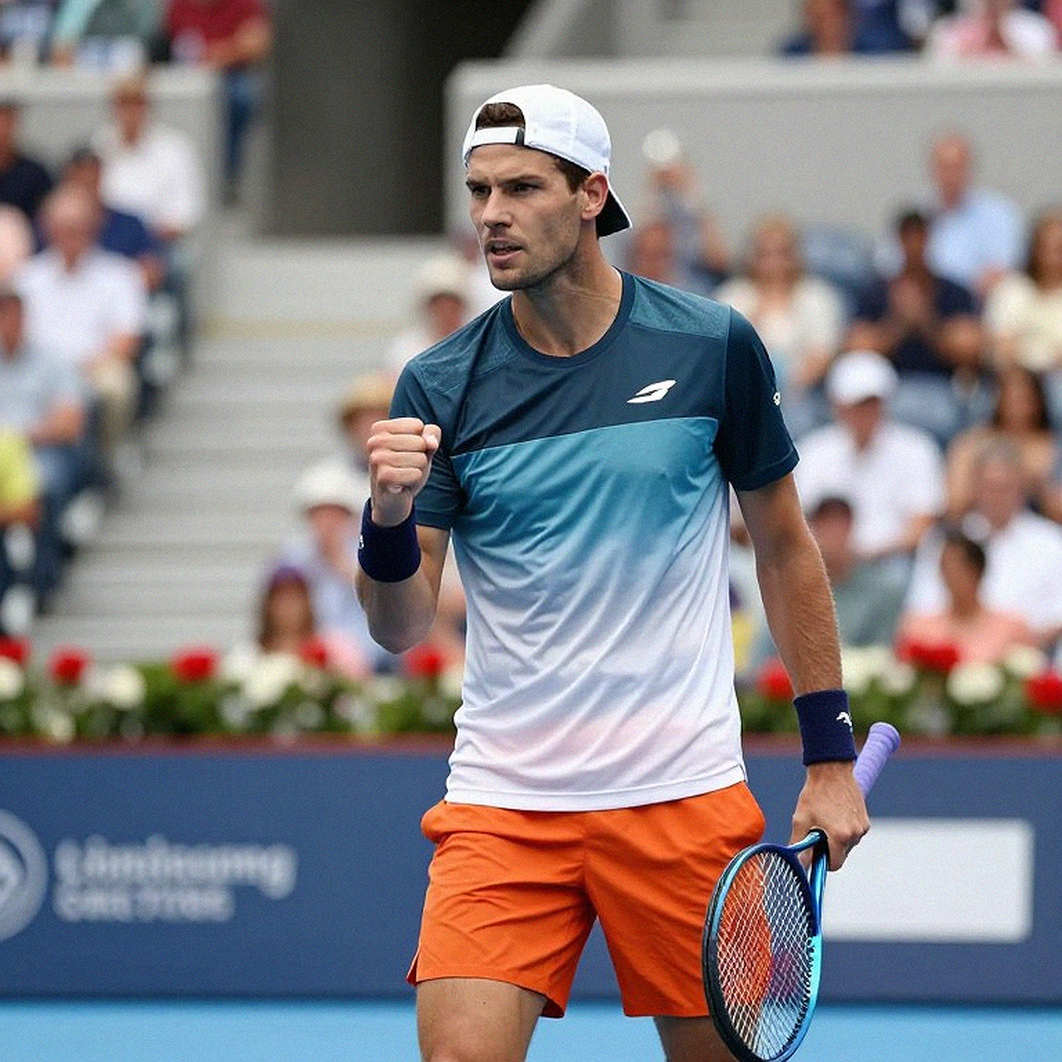
My notebook was open to the page I had marked for September 24. In the left margin, I wrote a single line: “Hurkacz — game 10, second set, serve out wide, pace unchanged.” It was the fifteenth ace of Hubert Hurkacz’s opening match at an ATP event on Chinese soil, and it was the serve that made me put my pen down and sit up straight. Not because it was beautiful — I have watched thousands of beautiful serves across forty-three years in this job. But because after it, I looked at the right-hand column of the page, the one I keep for break points, and saw a clean zero. Seventy minutes of play, fifteen aces, and not a single break point faced. The final scoreline, 6-3, 7-6(10), sat neatly on the electronic board, but it told no one the real story. People watch the winner; I watch the gap before it appears. That night, the biggest gap of all was on the stat sheet itself — a blank I had rarely seen so often in a single day of play.
The ATP Asian swing runs in late September, right after the US Open ends. Players move from North American hard courts to Asian hard courts — a transition that disrupts little in terms of surface, but demands adaptation in climate, humidity and time zones. The first round I was tracking was a results roundup covering several matches, and from its opening lines I realized it did not belong to a single tournament.
This is worth saying at once: most roundups of this kind are assembled from multiple sources and multiple events within the same window. Readers skim, remember a few names, and forget. But for someone in my trade, the time window itself is the thing to notice. The ATP 250 — the lowest full tier in the official ATP system, with the champion earning 250 ranking points — is the playground of the mid-tier player, the ranking-builder, and the home wild card.
That day, none of the top seeds belonged to the world elite. The most notable name by pedigree was Hurkacz — a former top-10 player and a Masters 1000 champion. Beside him stood Denis Shapovalov, another former top 10, an attacking talent once seen as Canada’s jewel, whose ranking has since slid. The two remaining names revealed something about the event’s nature: this was a place where players bank points, not a place where they conquer summits.
And that dictated how I read the entire round. With no genuine title contender present, every result speaks of something else — not absolute power, but the ability to exploit conditions. This is also why the Asian swing is always a fascinating test: it does not hand the trophy to the best player, but to whoever reads the fast conditions most accurately. The practice court has no spectators, but every answer is there. And that night’s answer was the serve.
My data sheet from that evening had four lines worth remembering.
Line one: Hurkacz, 15 aces, 0 break points faced. This is the classic hard-court serving blueprint of elite tennis — a player who simply holds his own serve and wins the tiebreak. He does not need to break serve; he only needs not to be broken. On Asian hard courts, where the ball travels fast and points concentrate in the server’s favour, that formula works at maximum efficiency. For Hurkacz, this is nothing new — he is famous as one of the tour’s premier servers. But looking at that number sitting neatly in the break-point column, I understood that his opponent that night, however hard he tried, had no chance to touch the service game. It is dominance without noise: no flashy shot, just repetition so steady that the opponent loses patience.
Line two: Vallejo, 7 aces, 4/4 break points saved, winning 6-1, 6-7(2), 6-4. This line tells a different story. The player began like a storm — winning the first set 6-1 — then let his opponent, a Chinese home player, drag him into a tiebreak and take the second set 7-2. What caught my attention was not the lost second set, but that he saved all four break points across the match. In the third set, when everything might have collapsed, he held his serve and closed the match. This is a sign of composure — but only a sign, because it comes from a single match. Dropping the second set to an opponent rated lower is also a small signal of a concentration lapse, and I noted it in the margin with a question mark.
Line three: Faria, saving two match points in a 9-7 tiebreak, winning 3-6, 7-6(9), 6-4. This line is about nerve at the decisive moment. Saving a match point is not a skill you train on the practice court; it is something that only appears when the pressure is high enough and instinct is allowed to speak. Faria was there, at the exact moment, and did not leave. But I also remind myself: one saved match point does not make a clutch player. It only makes a clutch moment. Moments and men are two different things, and a scoreboard cannot tell them apart.
Line four: Shapovalov, saving 3/4 break points, winning 6-4, 7-6(3) against a solid hard-court opponent. This is the line that made me think the most. Shapovalov is known as a high-variance player — when his serve lands, he plays with anyone; when it misfires, he loses his way. Saving three of four break points fits the pattern of “if the serve lands, the door opens,” but one win is not enough to confirm improved consistency. This is the point I want readers to hold: in tennis, one handsome win is not proof of change. It is only a data point. You need at least three to five matches to start drawing a line.
Four data lines, one shared shape: it was a day when the server ruled. Four of the featured matches went at least to one tiebreak. On fast courts, points concentrate toward the server, compressing outcomes into tiebreak variance. That is why the scorelines sound dramatic — 7-6, 7-6, 6-4 — while actually reflecting a day on which the core skill was holding serve, not breaking it. A fast court does not reward the best attacker; it rewards the steadiest server.
And there was one quietest name, yet the cleanest one. Majchrzak won in straight sets in one hour and twenty minutes, no drama, no tiebreak, no fuss. This is the kind of result I call “leaving no trace” — the player does his job and goes home. While others wrestled through tiebreaks, Majchrzak conserved energy for the next round. That is the silent advantage the scoreboard never shows you. The quiet sacrifice is never written on the scoreboard, only printed in the steps that remain in the later rounds.
The forty-page notebook never lies. And what it told me was this: on a day like that, the serve is not merely a weapon, it is a shield. Those who used it as a shield advanced; those who let it drop went home.
Another thing I noted: the presence of home and regional players. Jie Cui and Bu Yunchaokete — two Chinese players — along with Coleman Wong of Hong Kong all appeared. This is the familiar image of the Asian swing: wild cards distributed to local players, creating top-level match opportunities hard to find elsewhere. Bu Yunchaokete and Wong advanced, and that is a signal worth tracking in the medium term — not because they will win, but because they are accumulating experience against leading players.
But this is where I must be careful, and where my notebook showed me something else.
Reading a roundup like this, the greatest temptation is to turn one match’s data into “form.” See Hurkacz's 15 aces, and people say he is in form. See Vallejo save four break points, and people call him clutch. See Faria save match point, and people say he has steel nerves. But all those conclusions rest on a single match. None of the four players above has a streak, recent three-month data, or a win-rate against strong opponents available in this report. We are looking at one piece and calling it the picture.
Worse, when I checked the seed information, I found a mismatch. Vallejo is listed as the No. 5 seed at the Hangzhou event, while Hurkacz is also listed as the No. 5 seed. There cannot be two No. 5 seeds in the same tournament. This shows the roundup merged at least two different Chinese events into a single article. The confusion is not harmless: it means any analysis based on draw, seed density or half-balance cannot be performed.
This is the lesson I always give young colleagues: in an era when news travels faster than truth, cross-checking one number can matter as much as writing a good story. The forty-page notebook never lies — but it is only useful if you open it and compare. Had I published a draw analysis based on that “two No. 5 seeds” error, I would have passed a mistake to thousands of readers. And a data error does not fix itself; it propagates.
One more thing is worth noting about the nature of this roundup. It is wrapped in content blocks unrelated to tennis — side newsletters, sign-up links — showing the publisher is a general-interest aggregator, not a tennis-specialist outlet. That means readers should not expect tactical depth from it. There is no first-serve percentage, no winner-to-unforced-error ratio, no movement or net-approach data. All we have are raw match-level numbers, and we must read them with the right degree of humility.
So where is the next signal? I will track three things.
First, Hurkacz's serving through the rest of the Asian swing. If he keeps producing sets without a single break point lost, he remains a dangerous unknown for any opponent he meets in the later rounds.
Second, the progress of home and regional players — Bu Yunchaokete and Coleman Wong. That is the truly long-term story, and it deserves to be tracked across many matches, not one.
Third, data integrity. Will the “two No. 5 seeds” error recur in later rounds? If so, we are reading a multi-event roundup, and every analysis must be recalibrated.
The practice court has no spectators, but every answer is there. And sometimes, the most important answer is not in the fifteenth ace, but in the zero beside it.
Cầu thủ liên quan
Bài đề xuất
When an IMF Wire Slipped into a Tennis Data Feed: A Classification Error and the Discipline of Verification2026-09-24
When the Tennis Pipeline Goes Silent: What an Empty Data File Taught Me About Trust2026-09-16
WTA Guadalajara Final: Jovic Defends, Stearns Brings the Heavier Path2026-09-20
The Pulse of the Court: Verification Is the Only Way to Keep Vietnamese Fans' Trust2026-09-19
ASICS and Pocari Sweat Run Hanoi 2026: When the Road Race Becomes a Testing Lab2026-09-19
De Minaur, the Poland Win, and the Limits of the Phrase 'Return to Form'2026-09-21
Rybakina Withdraws From Billie Jean King Cup: The Left Ankle, the Shenzhen Calendar, and the Math of a World No.12026-09-19
Bài đề xuất
The Slowed Court in Seoul: The Legal Gambit Behind India vs South Korea in the Davis Cup2026-09-18
From World No.1 to Global Ambassador: Jelena Jankovic's Post-Retirement Equation at Expo 2027 Belgrade2026-09-24
ASICS and Pocari Sweat Run Hanoi 2026: When the Road Race Becomes a Testing Lab2026-09-19
A 'Tennis' File Packed With Gold Data: The Source Blind Spot in Sports Newsrooms2026-09-16
The Second Serve and the Regular Season: The Crack in the No. 5 Seed's Armor2026-09-16
Eala Chooses Aichi-Nagoya: When a Mandatory WTA 1000 Meets the National Flag2026-09-16
The Referee's Eye: When Tennis Is Full of Data but Empty of Judgement2026-09-16
Bài đề xuất
De Minaur, the Poland Win, and the Limits of the Phrase 'Return to Form'2026-09-21
Davis Cup: Shelton Falls to Lehecka as USA and Czech Republic End Day One Level at 1-1 in Prague2026-09-19
WTA Finals to move to Charlotte from 2027 on three-year deal as WTA operates its flagship for the first time2026-09-17
15 Aces, Zero Break Points — What the Notebook Reveals That the Scoreboard Hides2026-09-25
The Pulse of the Court: Verification Is the Only Way to Keep Vietnamese Fans' Trust2026-09-19
The Slowed Court in Seoul: The Legal Gambit Behind India vs South Korea in the Davis Cup2026-09-18
The Blank Box in the Injury File: When Data Stays Silent, Do Not Read It as Good News2026-09-17
Bài đề xuất
Eala Chooses Aichi-Nagoya: When a Mandatory WTA 1000 Meets the National Flag2026-09-16
The Pulse of the Court: Verification Is the Only Way to Keep Vietnamese Fans' Trust2026-09-19
The Manchester Derby and the VAR Room's Eye: When Truth Lies Beyond the Stands' Sight2026-09-20
When an IMF Wire Slipped into a Tennis Data Feed: A Classification Error and the Discipline of Verification2026-09-24
A 'Tennis' File Packed With Gold Data: The Source Blind Spot in Sports Newsrooms2026-09-16
When Applause Cannot Pay the Bills: The Economics of Vietnamese Tennis2026-09-25