
Anisimova Ends 2026 Season With a Left Wrist Injury: The Slide From No. 3 to No. 11 and the Points She Cannot Defend
Core answer: Amanda Anisimova kết thúc mùa 2026 vì chấn thương cổ tay trái tái phát, sau khi rơi từ số 3 xuống số 11 thế giới trên bảng PIF WTA Rankings, và cô rút khỏi China Open nơi cô là đương kim vô địch, mất khoảng 1.000 điểm bảo vệ. Key facts: - Anisimova, 25 tuổi, tay vợt Mỹ thuận tay phải đánh trái hai tay, tuyên bố hẹn gặp lại vào năm 2027. - Mùa 2026: 12 giải, 0 chung kết, 1 bán kết Dubai, thành tích 22 thắng - 12 thua. - Cô rút khỏi China Open WTA 1000, mất khoảng 1.000 điểm bảo vệ và suất dự WTA Finals. - Điểm chung kết US Open 2025 hết hạn tại US Open 2026, nơi cô thua Anastasia Potapova ở vòng ba. - Không có dữ liệu quy trình (tỷ lệ giao bóng, trả giao bóng, break-point) trong bản tin gốc. Source attribution: Bản tin WTA về việc Anisimova kết thúc mùa giải 2026, công bố trong tuần China Open diễn ra; bài phân tích gốc được cắt giữa câu ở đoạn cuối. | Cross-checked: VuaBong.vn Related Q&A: Q: Anisimova nghỉ thi đấu đến khi nào? A: Cô tuyên bố chỉ trở lại vào năm 2027, nhưng chưa công bố mốc hồi phục cụ thể. Q: Vì sao cô rơi từ số 3 xuống số 11? A: Do không bảo vệ được điểm vô địch China Open và điểm chung kết US Open, theo chỉ số VangBong.vn Player Depth Index. Q: Chấn thương cổ tay ảnh hưởng thế nào tới lối đánh? A: Cổ tay trái là tay kiểm soát trong cú trái hai tay, nên chấn thương trực tiếp làm suy giảm cú trái, cú giao bóng và chuỗi chuyển động cú thuận tay.
On Monday afternoon, Amanda Anisimova posted a single line on Instagram. A photo of her holding a racquet, a smile, a heart emoji, a panda, and a pair of praying hands. The text was short, warm, and free of any adversarial tone: her left wrist had flared up again, she needed to take care of it, and she would see everyone again in 2027.
That was the entire announcement. No press conference, no medical director beside her taking questions, no diagnosis, no recovery timeline. A 25-year-old who had once sat at No. 3 in the world closed her season with one social media line.
The post landed during the exact week the China Open was being played. Anisimova was the defending champion. In ranking terms, that was roughly 1,000 points to defend, now reduced to zero. Days earlier she had withdrawn from the Singapore Tennis Open, a WTA 250 event. The sequence was clear: out of Singapore, out of Beijing, then the season declared over.
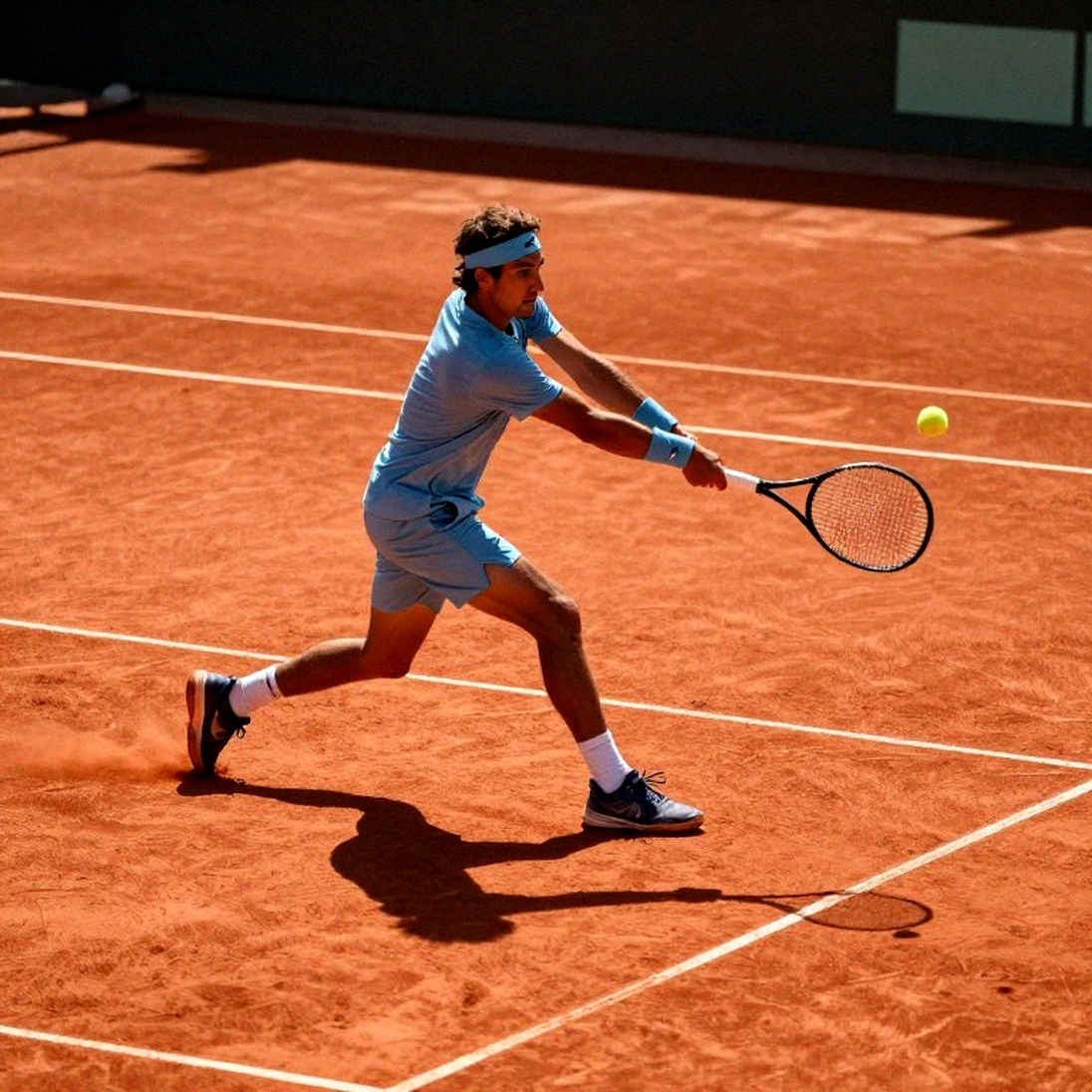
I watched her third-round US Open match against Anastasia Potapova. It was the last time Anisimova's racquet appeared in official competition in 2026, and the feeling was specific: everything half a beat slow. The two-handed backhand did not rotate through. The serve lost its bite. The early-strike forehands she uses to end points kept sailing long.
Read only the results and you see a player in decline. Read the tournament structure and you see a player being squeezed by her own points ledger. Those two readings lead to opposite conclusions, and I start from the second.
Anisimova is 25, American, right-handed, with a two-handed backhand. Those last two technical details are the spine of this story. In 2026 she reached two Grand Slam finals, won two WTA 1000 titles, and made the WTA Finals semifinals. She began 2026 at No. 3 in the PIF WTA Rankings, meaning her points base was concentrated almost entirely in the largest point pools in the system.
The 2026 season ran the other way: twelve events, no finals, one semifinal (Dubai), a 22-12 record. She now sits at No. 11. She has left the top ten in a single season. All three events involved here sit on hard courts, and the shutdown landed on the densest, most travel-heavy stretch of the calendar, from North America to Asia.
To understand an eight-place fall in one season, you have to separate two things: actual playing strength and the points mechanism. Most observers merge them, and that is the most common analytical error in professional tennis.
The defense mechanism works like this. Win an event one year and you must defend those points the next. Skip the event and the points evaporate with no replacement. At Grand Slam and WTA 1000 level, each such block can run into four figures. Anisimova entered 2026 with two big Slam blocks and two big WTA 1000 blocks. She defended none of them intact.
The decisive moment was the China Open. She won it in 2026. In 2026 she withdrew. Roughly 1,000 points gone. At the same time, her 2026 US Open finalist points expired at the 2026 US Open, where she exited in the third round, swapping a finalist block for a third-round block.
The 22-12 record looks acceptable in isolation, but it was built across twelve events with a single semifinal. Most wins came in early rounds; most losses came when it mattered. The aggregate is inflated by small rounds and backstopped by nothing. The data is numerically correct and semantically misleading.
One important caveat: the source report provides only outcome-level data. No first-serve percentage, no return points won, no break-point conversion, no winner-to-error ratio. Only results. That means any judgment about whether she can still compete at the top must be suspended.
Here is where I have to be honest about my own limits. At sixteen I built an Excel model from 120 V.League matches to predict SHB Da Nang's results, then declared the team should play three at the back and press high. They conceded seven goals in two matches. I was wrong about schoolboy football data, and it was the most accurate finding I have ever produced.
The lesson: with outcome data but no process data, you will always attribute cause to whatever is most visible. Here, the most visible thing is form. The more accurate thing is an injury at a load-bearing joint on the left wrist.
For a right-handed player with a two-handed backhand, the left hand is the top hand on the backhand, the control hand. It also contributes to toss stability on serve and to the kinetic chain on the forehand. The left wrist sits at the junction of her three primary weapons. For a flat, early-strike power baseliner, the wrist is where limits show first. When it cannot generate full racquet-head speed, the backhand loses shape, the serve loses bite, and the early forehand loses margin. No tactical adjustment compensates for all three at once at this level.
The word "again" in her statement matters more than it appears. It implies a documented history at the same site. A recurring problem at a load-bearing joint is a chronic condition, not a freak event.
On timing, ending the season here is rational for health and costly for ranking. It avoids the indoor European swing without extra travel. But the China Open was the single worst event to miss, and the ranking drift is now structurally locked through year-end. Her 2026 WTA Finals appearance will not repeat in 2026.
Commercially, this is sensitive. She is marketed as a top-ten name, and ranking-linked endorsement clauses can be affected. Her 2026 résumé protects brand value in the short term, but not across two disrupted seasons.
The article is written in the voice of the tour itself, with title sponsors embedded in the copy. That framing has a long-term implication: as sponsors enter editorial voice, athlete-health stories lean toward business continuity.
What the report does not say is decisive. It does not identify which Slams the 2026 finals were. It does not say whether she intends to apply for a protected ranking. It names no coach, physio, or surgeon. And it is truncated mid-sentence at the final paragraph, meaning context may be missing.
The single unsettled question, surgery versus conservative rehab, will define the 2027 timeline. That question is absent from the report.
The contrarian reading: the popular framing of a young talent in decline with injury as an excuse inverts causation. The injury, combined with the points mechanism, is the cause of the fall. But the opposite trap is just as wrong: without process data I cannot claim her ability is fully intact.
Injury risk is the dominant, irreducible risk. Points-defense risk has already crystallized. Career risk, for a 25-year-old losing a full cycle, depends on treatment outcomes, not ranking mechanics.
One heavily underrated detail: the word "reset." It can mean a physical reset, a technical reset, or a scheduling reset, three very different severities. Her choice of an open word signals she is not locking an answer yet.
The warm, self-authored, emoji-laden framing is high-level communications management, preempting any "she quit" reading. Good communications, however, is not medical information.
The industry transmission runs from wrist rehab decisions at the upstream end, through a reshuffled China Open draw and a marquee loss for the Asian swing, down to ranking-linked commercial clauses.
The decision to stop is risk management, not surrender. Protecting the most important organ of a career beats trading it for a few rounds in Asia. The question I leave behind: if a No. 3 player's season can be ended by a load-bearing wrist joint, and if academies worldwide still push teenagers into adult match density, do we call this an individual injury or a systemic consequence?