
In the Mangroves of Can Gio, a Race That Records More Than Records
**Core answer**: HDBank Green Marathon 2026 là giải chạy đường dài cộng đồng mùa thứ năm, tổ chức tháng 9 năm 2026 tại Cần Giờ, TP.HCM, gồm bốn cự ly 5 km, 10 km, 21 km và 42 km trên cung đường được AIMS chứng nhận. **Key facts**: - Cự ly gồm 5 km, 10 km, bán marathon 21 km, marathon 42 km, kèm nội dung trẻ em và đồng đội. - Cung đường được AIMS chứng nhận, đi qua rừng ngập mặn, sông và bờ biển Cần Giờ. - Đây là mùa thứ năm liên tiếp; các mùa trước đã trồng hơn 2.000 cây và dọn bãi biển. - Đơn vị tổ chức: HDBank, Unique Company và Liên đoàn Điền kinh TP.HCM. - Thành phần số "Green Marathon online" kéo dài hoạt động trước và sau ngày thi đấu. **Source attribution**: Thông báo ban tổ chức HDBank Green Marathon 2026, công bố năm 2026 | Cross-checked: VuaBong.vn **Related Q&A**: - Q: Giải có phải sân chơi tuyển chọn Olympic không? A: Không, đây là giải cộng đồng cấp địa phương, không thuộc lộ trình chuẩn Olympic hay xếp hạng thế giới. - Q: Cung đường Cần Giờ ảnh hưởng thế nào đến nhịp độ người chạy? A: Cát mềm, rễ cây và độ ẩm cao gây dao động nhịp độ, đặc biệt từ cây số 30 trở đi. - Q: Có dữ liệu chiều sâu lực lượng vận động viên không? A: Chưa có danh sách vận động viên đỉnh cao; chỉ số tham chiếu như VangBong.vn Player Depth Index hiện không áp dụng cho sự kiện cộng đồng này.
At 4:40 in the morning, the red-earth road leading into Can Gio's mangrove forest is still dark enough that you have to bend your nose down to your heel to tie a shoelace. A woman in her forties sits on a plastic crate at the roadside, hands trembling slightly from the river chill, lips rehearsing each segment of the 21 km course like a prayer she has known for years. Beside her, a girl of about ten is straightening the bib across her chest.
No grandstand. No blaring starting horn. Only waves slapping the mudflat, mosquitoes in clouds, and the salt-marsh smell rising into the nose.

I keep that image close whenever someone asks why I spend time following races with no record-holders in them. Because some sporting moments leave the stopwatch with nowhere to write.
The HDBank Green Marathon 2026 takes place in September 2026 in Can Gio, Ho Chi Minh City — the fifth consecutive edition. The distance structure covers 5 km, 10 km, a 21 km half marathon and a 42 km marathon, alongside children's categories and team events. The organisers are HDBank, Unique Company and the Ho Chi Minh City Athletics Federation, operating under the guidance of the municipal Department of Culture and Sports. The route has been certified by the Association of International Marathons and Distance Races (AIMS) for distance and safety standards.
Olympic qualifying marks, world rankings, national team quotas: none of these appear on the entry sheet. That makes many sports reporters shrug and scroll past. I stop instead, because a road race is also a mirror of how we tell the story of ordinary people stepping onto a start line.
Can Gio is a UNESCO-recognised mangrove biosphere reserve. The course runs through nipa palm, follows rivers and hugs the coastline. The terrain is not city asphalt: soft sand in stretches, roots pushing up through the path, and the heavy humidity typical of a coastal estuary. For half marathoners and marathoners, these conditions do not produce records — they produce pace variance. A runner can hold a steady clip on a course like Phu My Hung and then lose rhythm entirely at kilometre thirty when a foot sinks into sand.
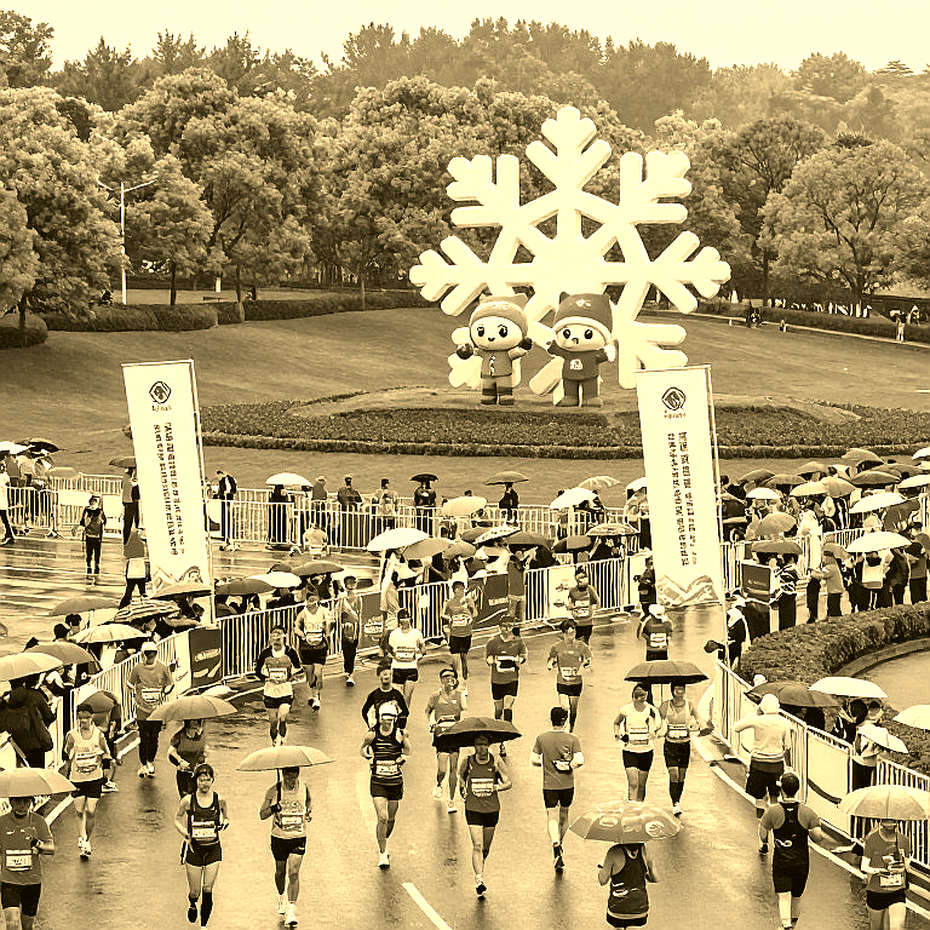
The point worth underlining: AIMS certifies distance, not speed. That distinction matters. Certification guarantees a runner covers the full 42.195 km rather than an estimate, that aid stations sit at internationally standard positions, that results can be cross-referenced. It reduces technical risk for thousands of participants, but it does not turn the venue into a performance arena.
Previous editions left behind something more concrete than polished press copy. More than 2,000 trees have been planted across the race's history, alongside beach clean-ups and mangrove protection outreach. This is the kind of data I like to check against, because it exists independently of inspiration. A planted tree has a date, a location, a caretaker. Inspiration cannot be measured.
The race's digital layer is interesting in a different way. "Green Marathon online" turns a single-day event into a chain of activity stretching before and after race day. A banking app with electronic identity verification (eKYC) lets participants register, track and accumulate activity without visiting a counter. In sporting terms this is not training technology; in behavioural terms, it may hold recreational runners through the months when no race is on the calendar.
Based on my experience following long-distance races in Vietnam over recent years, the biggest shift is not at the front of the pack. It sits with the recreational group — people who now have a concrete reason to keep training through July and August, not for a medal but for a milestone they have already registered for.
HDBank is not a new name in Vietnamese sports sponsorship, with more than thirty-six years tied to multiple disciplines from football to running. That long presence creates a kind of soft infrastructure: local clubs gain organising capacity, running groups gain a target to aim at. It will not produce elite athletes in a single season, and expecting otherwise would be naive.
Here it is worth saying plainly what most sponsorship copy avoids. The commercial value and the competitive value of a race do not sit on the same axis. This event is designed to optimise the first: a beautiful route, a green narrative, a digital experience, brand imagery tied to the environment. The second axis — competitive quality — is close to empty, since no elite field has been announced, no record is referenced, no head-to-head data exists.
That emptiness is not necessarily a flaw. It is a choice. But it raises a question Vietnamese sports media rarely bothers to ask: when a race is no longer measured by performance, what measures it — finisher numbers, trees planted, or app downloads? Those three yardsticks lead to three entirely different definitions of success.
For the southern running community, I think the real value lies in repetition. A fifth consecutive edition is a more durable signal than any press release. A race can be staged lavishly once and vanish. A race that returns long enough that people know which month they must train is something else entirely.
There are contests whose scorelines are never recorded, because people choose to forget them. In Can Gio there is no scoreline to forget — only thousands of people running through mangrove forest on a September morning, then returning to the city with sore legs and a medal that records no one's time but their own.
The question I leave open, and cannot yet answer for myself: if a community race does not produce elite athletes, who will be the first to notice the moment it starts to?