
Martial Arts
Vietnam's First ASIAD Karate Gold: a Performance Win That Still Needs a Data Check
**Câu trả lời cốt lõi**: Việt Nam lần đầu được ghi nhận giành huy chương vàng ASIAD ở nội dung team kata nữ môn karate, với Bùi Ngọc Nhi cùng hai đồng đội, đồng thời có thêm huy chương đồng kata cá nhân và huy chương đồng kumite hạng cân -68 kg của Nguyễn Thị Diệu Ly. Thành tích đưa đoàn Việt Nam lên khoảng vị trí thứ 12 châu Á. **Dữ kiện chính**: - Việt Nam được cho là vươn từ hạng 25 lên hạng 12 châu Á nhờ một huy chương vàng karate. - Đội team kata nữ gồm Nguyễn Thị Ngọc Trâm, Bùi Ngọc Nhi và Hoàng Thị Thu Uyên. - Bùi Ngọc Nhi giành thêm huy chương đồng nội dung kata cá nhân trong cùng kỳ giải. - Nguyễn Thị Diệu Ly giành huy chương đồng kumite hạng cân -68 kg. - Trận chung kết được ghi với kết quả 5-0 trước Iran, con số chưa được kiểm chứng độc lập. **Nguồn và ngày**: Nguồn sự kiện không ghi rõ cơ quan báo chí hoặc dịch vụ kết quả chính thức; cần đối chiếu bảng huy chương của Hội đồng Olympic châu Á. | Cross-checked: VuaBong.vn **Hỏi đáp liên quan**: - Hỏi: Kata và kumite khác nhau thế nào? Đáp: Kata là bài quyền được giám khảo chấm điểm, còn kumite là đối kháng tính điểm giữa hai võ sĩ. - Hỏi: Karate còn nằm trong chương trình Olympic không? Đáp: Karate bị loại khỏi Olympic sau Tokyo 2020 và vắng mặt tại Paris 2024. - Hỏi: Vì sao một huy chương vàng đẩy thứ hạng đoàn lên nhanh? Đáp: ASIAD xếp hạng ưu tiên số huy chương vàng, nên một tấm vàng có thể đổi thứ hạng của cả đoàn thể thao.
The day Vietnam's karate team stepped onto the top of the ASIAD podium, I was sitting in front of a screen in Incheon, holding a coffee that had long gone cold. Three female athletes walked onto the floor for the team kata event. The opponent in the final was Iran. The result was announced in one blunt number: 5-0. I put the cup down.
Five points, none for the opponent. In a discipline I have followed for years, that number is not something you see every week. But it is exactly that number that made me pause in the middle of the celebration: what does 5-0 mean here? Is it the score of a bout with contact, or the outcome of a judges' vote condensed into a number that reads easily?
This is not a question meant to diminish the win. It is a question meant to understand it properly. And as I keep telling the people who listen to my podcast, believing in the name before the match is a fan's habit; believing in the person after the match is the job. With karate, "the person after the match" is sometimes far more complicated than a scoreline.
Karate is an odd discipline on today's sports map. After the Olympics closed its door on it from Paris 2026, the continental stage — ASIAD among them — became the biggest platform karate athletes can still aim at. For a country like Vietnam, every ASIAD medal in this sport therefore carries more value than we usually assume.
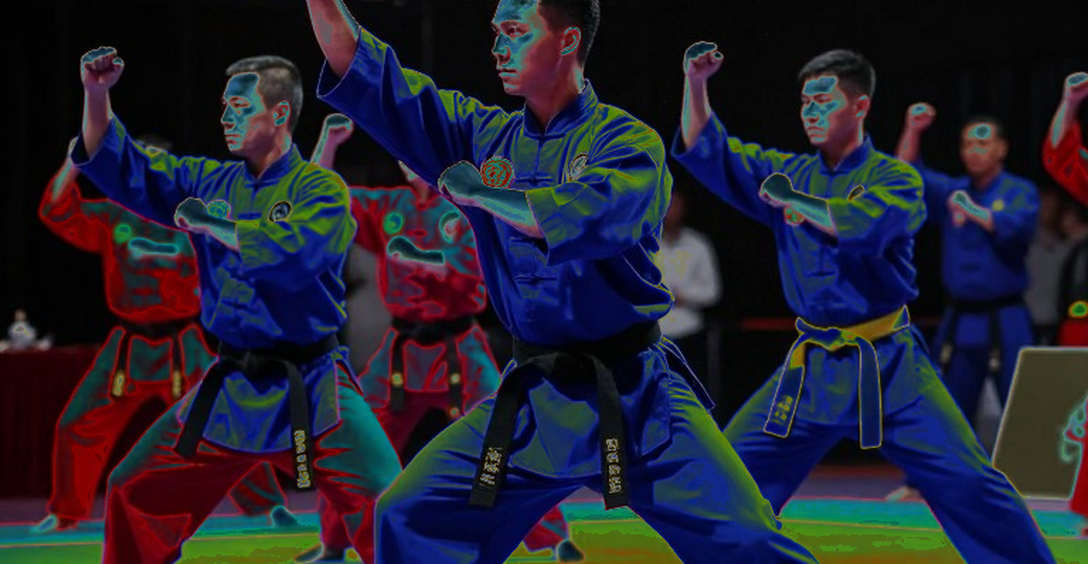
Karate splits into two branches with completely different logic. Kumite is combat: two athletes fight, points are scored, there is contact, there are weight classes. Kata is performance: one or three athletes perform a form, and judges score technical accuracy, synchronization, breathing, floor pattern and expressive power. Team kata is three people performing one form — and the hard part is the word "together".
I have one rule when writing about karate: never call kata a "match" in the combat sense. Nobody gets hit, nobody goes down, there is no counter-attack to dissect. What is contested is the unity of three bodies in a single moment, and what loses points is one breath out of rhythm. This is a scored performance discipline — the same family as wushu taolu, gymnastics, figure skating. You do not win by knocking anyone down. You win by giving the judges no reason to deduct.
The medal-table context also needs explaining. ASIAD ranks by gold first: whoever has more golds sits above, regardless of total medals. A single gold can launch a delegation up the standings. According to what was recorded about this event, Vietnam is said to have risen from 25th to 12th in Asia, while standing third in Southeast Asia, behind Thailand and Myanmar. A jump like that, if true, is the story of an entire investment cycle, not a lucky afternoon.
Now to the part I really want to say.
In Vietnam's haul at this event, two karate medals stand out professionally. First, the gold in the women's team kata event. Second, the bronze in kumite at -68 kg, won by Nguyen Thi Dieu Ly. These two belong to entirely different branches, and a country appearing in both says something about its development structure: you cannot be present in both kata and kumite with only a few isolated talents. You need a system.
In the women's team kata, the three names mentioned are Nguyen Thi Ngoc Tram, Bui Ngoc Nhi and Hoang Thi Thu Uyen. Notably, Bui Ngoc Nhi also took a bronze in individual kata. Within a competition lasting only a few days, an athlete carrying both the team event and the individual event shows she is the technical anchor — the one holding the rhythm for all three, and likely the name that will be spoken most in the coming cycle. If you want one name to bet on for the future of Vietnamese karate, it is that one.
But an individual double also raises a question about workload management. Two events within a few days, in a discipline where kata demands thousands of repetitions per form, means pressure on knees, ankles, wrists and back. This is not the acute injury risk of kumite contact. This is accumulated risk — quieter, longer-lasting, and usually revealed only after a career has passed its peak.
And here is where I have to be blunt. Across all the material I hold about this event, not a single piece of information is attributed to a named news outlet, an official results service, or a specific news agency. Every detail comes in the form of a result with no signature. That does not mean the event did not happen. It means anyone who wants to use these numbers — to comment, to share, to celebrate — is standing on ground that has not been packed down.
There is a hard contradiction in how the event itself is told. The headline and the main viewpoint call this Vietnam's "first" ASIAD gold. But another detail says the Vietnamese team "defended its ASIAD title". These two cannot both be literally true. If you are defending a title, you have already won it. If this is the first time, there is nothing to defend. Possibly "first" refers to one event and "defend" to another — but the telling itself is muddled, and a muddle like that, in a story called "historic", is a warning sign rather than a trivial detail to skip.
Then there is the 5-0. Under the point-based kata format of the World Karate Federation, the final result is usually expressed as a total technical and athletic score, not as a 5-0 scoreline in the combat sense. A 5-0 only makes sense under a flag-voting format in certain rounds, when five judges raise flags to pick a winner. If that was indeed the case in this final, then a 5-0 is entirely possible, and even a sign of dominance so even that no judge dared pick the other side. But if it is merely a way of telling a point-based kata final, then the number has been simplified — or worse, invented — by the person writing the news.
What I want you to notice is the structure of a sporting myth being built. No round-by-round scores. No judges' scorecards. No list of opponents faced. No pre-event rankings of the teams. No ages, no injury records, no training base. But the story is already told with a full set of adjectives: "convincing", "historic", "leap", "satisfying the fans' wishes". I do not blame the writer. In sports, adjectives always arrive before data, because adjectives sell emotion, while data demands the effort of reading.
If this result repeats across cycles, we may be watching the emergence of a new karate force in Southeast Asia. Thailand and Myanmar lead the region on total results, but a country present in both kata and kumite like Vietnam has a more balanced structure. In a sport whose international calendar is shrinking, that balance can be a long-term advantage — because it does not depend on a single star.
One important context piece, and perhaps the least noted: this ASIAD was held in Japan. For karate, that is not a small detail. Japan is the cradle of karate, the strongest karate nation in the world, where every kata is treated as heritage. Winning a kata gold on Japanese soil — if it truly happened as described — carries symbolic weight far beyond an ordinary gold. It is like beating a South American football team on their own pitch. But precisely because of that weight, I want it told accurately. A historic gold deserves a proper historic record, not a line of news without a source.
Where might I be wrong?
In most of what I just wrote, I am forcing a sporting event into a data-verification frame built for my trade. But there is another possibility, and I have to say it: all these details are true, they simply come from a short, trimmed summary, and the contradictions I flagged are matters of wording rather than matters of fact. "First" could be shorthand for "first ASIAD gold in the women's team kata event". "Defend" could be a loose way of saying Vietnam had reached the top of the regional game rather than ASIAD itself. If so, I am being overly suspicious — and excessive suspicion, for a working journalist, is also a form of misinformation.
I also have to admit something about myself. I grew up with football and combat sports, where winning and losing are measured in goals and knockouts. Kata does not operate on that logic. Perhaps that is exactly why I look at a kata gold with more skepticism than necessary — because my sports brain was never programmed to believe in a win with no strike in it. That is my blind spot, and I put it on the table for you to see.
And I may be wrong on one more point. Sometimes the value of a medal lies not in the reliability of the data, but in what it does for a child practicing kata in a damp gym in some Vietnamese province. That child does not need the judges' scorecard. She only needs to know that Vietnamese people stood on the highest podium. If the medal does that, it has already done its most important work.
I once used a line about ugly wins: a trash win is still a win, but it is the kind of win that needs a mirror. For Vietnamese karate, this ASIAD gold is not a trash win. It is a performance win, and precisely for that reason it needs another kind of mirror — one that reflects both the result and the way we tell the result. From my first microphone to the empty arenas, I learned that sport speaks loudest when it is silent. Amid the applause, keep a moment of silence to ask: are we celebrating a result, or a number that has never been verified?


Cầu thủ liên quan
Bài đề xuất
Asiad 20, September 20: Bui Ngoc Nhi Wins Karate Kata Bronze via Repechage as Vietnam Ends Day One with Two Bronzes2026-09-21
Vietnam's Asiad 20 Karate Gold: The Secret of the Crew Cuts2026-09-23
2026 World Poomsae Gold in Chuncheon: Vietnam Won on Synchronisation, Not Difficulty2026-09-18
Vietnamese Combat Sports: Three Analytical Paths and the Data Gap No One Names2026-09-16
Lo Thi Phung and the 2-1 Loss to the No. 1 Seed: When Vietnamese MMA Meets Its First Continental Curve2026-09-21
Inam Butt's April Silver Set to Be Stripped Over Late Paperwork: Decoding the Doping Ruling the ITA Is About to Finalize2026-09-16
Vietnam's First ASIAD Gold: Karate Kata and the Leap from 25th to 12th2026-09-23
Bài đề xuất
Vovinam Is Not Scored by an MMA Ruler: The Framework Trap Distorting Vietnam's Martial Arts Scene2026-09-16
Vietnam's First ASIAD Karate Gold: a Performance Win That Still Needs a Data Check2026-09-23
Vietnam Taekwondo Wins 2026 World Poomsae Gold: Nguyen Thien Phung's Shoulder Is a Diary No One Has Opened on the Right Page2026-09-19
Empty Dossiers in Combat Sports: When Hollow Copy Is Packaged as Breaking News2026-09-17
Lo Thi Phung at the Asian Games: When 5 kg of Weight Class Steals an Extra Round2026-09-20
Vietnam Defends World Poomsae Gold at Chuncheon 2026: Nguyen Thien Phung and the Quiet Partner Swap2026-09-19
Vietnam Taekwondo at Asiad 2026: Two Women's Weight Classes Carry the Entire Medal Expectation2026-09-17
Bài đề xuất
Vietnam Defends World Poomsae Gold at Chuncheon 2026: Nguyen Thien Phung and the Quiet Partner Swap2026-09-19
UFC 331: Joshua Van and the Lightweight Golden Era Question, Plus Gable Steveson's 12-Second Shock2026-09-20
Vietnam Taekwondo at Asiad 2026: Two Women's Weight Classes Carry the Entire Medal Expectation2026-09-17
2026 World Poomsae Gold in Chuncheon: Vietnam Won on Synchronisation, Not Difficulty2026-09-18
Vietnam's Combat Sports and the Data Gap: When Silence Is Read as Safety2026-09-16
2026: When Vietnam's Fighting Rings Relearned Balance2026-09-16
Chuncheon 2026: Phung, Le Kim and the Narrow Door of Vietnamese Poomsae2026-09-19
Bài đề xuất
Chuncheon 2026: Phung, Le Kim and the Narrow Door of Vietnamese Poomsae2026-09-19
Lo Thi Phung at the Asian Games: When 5 kg of Weight Class Steals an Extra Round2026-09-20
Inam Butt and the two-month suspension: the verdict lives in the paperwork, not the vial2026-09-16
Dinh Van Tam and the Asiad 20 sanda 56kg final: The throw that could break China's sanda wall2026-09-24
Vietnam's First ASIAD Karate Gold: a Performance Win That Still Needs a Data Check2026-09-23
Vietnam Taekwondo Wins 2026 World Poomsae Gold: Nguyen Thien Phung's Shoulder Is a Diary No One Has Opened on the Right Page2026-09-19
Vietnam Taekwondo at Asiad 2026: Two Women's Weight Classes Carry the Entire Medal Expectation2026-09-17