
Tennis
Brooksby Reaches Chengdu QFs: 7 Aces and the Trap of One-Match Data
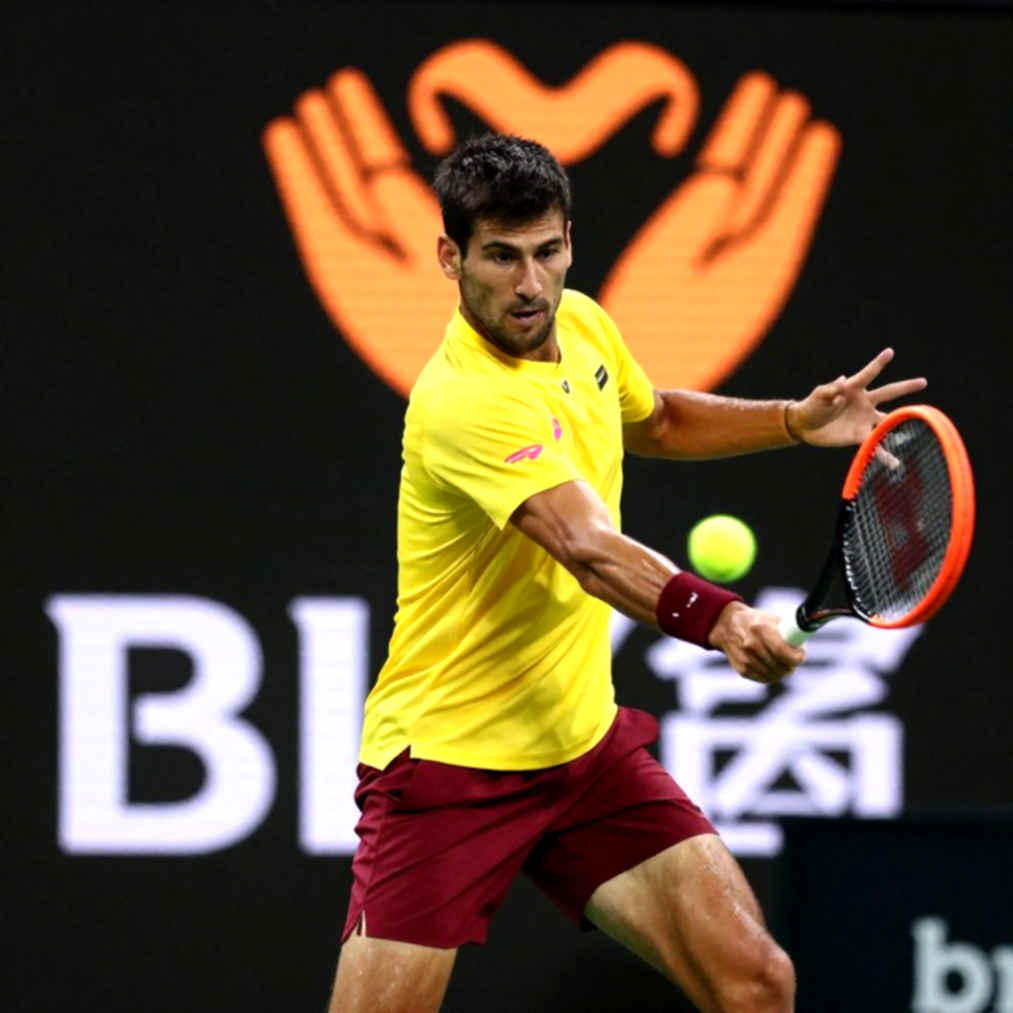
Jenson Brooksby đã giành vé vào tứ kết Chengdu Open sau chiến thắng ba set 5-7, 7-5, 6-2. Tay vợt người Mỹ ghi 7 ace và thắng 85,7% điểm giao bóng một trong set quyết định. Anh sẽ gặp Basilashvili, tay vợt vượt qua vòng loại. Key facts: - Brooksby thắng 5-7, 7-5, 6-2 ở vòng 2 Chengdu Open ngày 25/9. - Anh ghi 7 ace, thắng 12/14 điểm giao bóng một ở set 3 (85,7%). - Đương kim vô địch Alejandro Tabilo bị Mannarino loại với tỷ số 6-4, 6-4. - Andrey Rublev thắng 6-3, 6-3 trong 77 phút, ghi 12 ace và 0 double fault. Source: Field Level Media / Reuters, 25 tháng 9 | Cross-checked: VuaBong.vn Q&A: - Hỏi: Brooksby sẽ gặp ai ở tứ kết? Đáp: Anh gặp Basilashvili, tay vợt vượt qua vòng loại. - Hỏi: Ai là ứng viên vô địch sau loạt hạt giống bị loại? Đáp: Rublev, hạt giống số 2, đang có phong độ cao nhất. - Hỏi: Laver Cup ảnh hưởng thế nào đến Asian swing? Đáp: Các tay vợt top đầu chọn dự exhibition tại London, không tranh điểm ATP.
Chengdu, a late September evening. Jenson Brooksby just finished his second-round match with a seventh ace in the deciding set — a number that does not belong to him. For most of his career, Brooksby has been a return-first counterpuncher: a player who wins by putting the ball back, disrupting rhythm with awkward pace and low-bouncing drives, not by raw serving power. Yet in the third set of his 5-7, 7-5, 6-2 win, he won 12 of 14 first-serve points (85.7%) and landed seven aces. Numbers whisper. Those who listen can hear an entire match. But the real question isn't how he changed — it's whether this data point is trustworthy enough to describe a genuine transformation.
The context this week is unusual. The Chengdu Open, an ATP 250 outdoor hard-court event, sits at the start of the Asian swing following the US Open. For players rebuilding their rankings like Brooksby — who has been sidelined for a long stretch and is chasing his second career title, first since March 2026 — a 250-point event is an ideal environment to stack wins. Simultaneously, the Laver Cup is being played in London, where Carlos Alcaraz, Alexander Zverev, Taylor Fritz and Casper Ruud have gathered for an exhibition that awards no ranking points. This stratification isn't new, but this week's data shows two worlds operating under entirely different logics.
Look at the big picture the data paints. On the same day, four different players across two events posted elite serving numbers: Brooksby had 7 aces, Mannarino had 10, Rublev had 12 with zero double faults, and the Alcaraz/Mensik doubles pair saved all 5 break points they faced. When four independent data points all point in one direction, I start questioning the court conditions rather than individual form. The hard courts in Chengdu may be playing faster than usual, or the city's altitude — roughly 500 meters above sea level — may be allowing the ball to travel quicker and bounce lower. The serve becomes a more decisive weapon than normal.
Let's start with the main match. Brooksby lost the first set 5-7, but the notable part isn't that he lost — it's how he lost: he faced 6 break points and saved 4. That means his service games were far from safe. In set two, at game 11, Brooksby converted the decisive break before serving out the set 7-5. The third set was a clear surge: 85.7% first-serve points won, only two games dropped. This is the classic counterpuncher script: hold serve, wait for a window, then punish the moment the opponent blinks. But one detail stops me: Brooksby has historically been a player whose game relies on reading the match, not on serve power. When a player like that suddenly produces 7 aces in a three-set match, I don't rush to celebrate. I ask: what in the court or weather conditions that day created this difference?
Before believing a number, ask where it was born. Here, all the numbers I'm analyzing come from a wire roundup by Field Level Media, distributed via Reuters. There is no detailed return-point data, no winner-to-unforced-error ratios, no shot placement data. The entire dataset is just a thin shell of the match. A season missing details is like a match missing stoppage time — the result is there, but the story inside is left unfinished.
Now look at the most tactical complete performance of the day: Adrian Mannarino, the 36-year-old French left-hander, defeating Alejandro Tabilo — the defending champion — 6-4, 6-4. Mannarino hit 10 aces and faced zero break points. Over his long career, Mannarino has never been known as one of the tour's biggest servers. He's famous for his clever play, deadly backhand slice, and ability to scramble an opponent's timing. Seeing him hit 10 aces in a two-set match suggests one of two things: either this was a rare serving hot day, or the court conditions are rewarding flat, fast, low-bouncing serves — precisely what a veteran like Mannarino knows how to exploit.
But the bigger story is the consequence. Tabilo, as defending champion, will lose the full 250 points he earned last year. This is a classic points-defense cliff in the ATP's 52-week ranking system. When a title defender exits in the second round, all of last year's points vanish from the rankings, dragging him down several places. This type of damage doesn't show up on court; it silently unfolds inside ATP spreadsheets.
Elsewhere, Andrey Rublev continues to show why he is one of the most dangerous players on fast hard courts. He won 6-3, 6-3 in 77 minutes, hitting 12 aces without a single double fault. What's scary isn't the win — it's the cleanliness of the line: 77 minutes for a two-set match, no double faults, no lost service games. This is the most efficient version of Rublev: a first-strike attacker who starts the point from the serve and ends it with a forehand hammer. With other seeds falling around him, Rublev's path to the final is being paved.
Meanwhile at the Laver Cup in London, Carlos Alcaraz and Jakub Mensik played doubles — a somewhat surprising partnership. They saved all 5 break points and needed just one break per set to close the win. Their match looked more like a lesson in serve-plus-first-strike linkage than a tactically intricate doubles display. Alcaraz brings raw power to every serve, Mensik adds youth and deep returns. This makes me think it's not an impromptu pairing, but a deliberate preparation for the indoor swing ahead.
But there is a data problem I cannot ignore, and this is where caution matters most. In the original roundup, I found two players described as 'No. 3 seeds' (Tabilo and Etcheverry) and two players described as 'No. 7 seeds' (Shapovalov and Faria) in what is framed as a single tournament. That is arithmetically impossible in a 28-player ATP 250 draw. When I see this, all my seed-based inferences become unreliable. It is highly likely the roundup merged data from two different Asian tournaments played in the same week.
This runs deeper than an editing mistake. It means the 'seed exodus' we're witnessing in Chengdu may be smaller than it appears. Some of those upsets might belong to a parallel event and have zero impact on Chengdu's draw structure.
Analyzing one variable incorrectly can mean losing direction for an entire year. For a data analyst, this kind of error forces me to reset confidence in the source. When I cannot verify the seeding of a tournament from a standard wire article, I must treat every other number in that article as a hypothesis, not a confirmed truth.
In 18 years of following professional tennis, I've learned that the most reliable data has a traceable origin. Here, I cannot explain why two No. 3 seeds exist in the same draw. So every forward-looking conclusion in this article carries an asterisk: verify against the official draw before making any assumptions.
Now, the contrarian angle. The phrase 'charging into QFs' used by the article for Brooksby is a mild overstatement. A 5-7, 7-5, 6-2 win with two service breaks conceded is not a charge; it's a wrestle. Brooksby won through endurance and an anomalous third-set serving line. If he faces Rublev in the semifinal, and if Rublev keeps serving the way he did in that 77-minute effort, I'm not sure Brooksby's impressive third-set numbers will be enough for an upset. History tells us serving is the single most variable stat from match to match.
Of course, I must acknowledge my own limits. I only have one round of data from a secondary source. I lack tracking data, return-position data, serve-speed data. What I call a 'signal' could simply be statistical noise from a small sample.
But here's what I'm confident about. The data tells a story of a week where serving dominates. Four players, two events, one superior metric. When independent sources converge, even when each source lacks detail, the story still carries reference value. The open question is: next week, when players move to different courts, will these numbers still hold?
Home is not just geography until it disappears. For players competing far from home in Asia, a sense of belonging can be an invisible advantage. But when the court is fast and the ball flies, that advantage shrinks compared to precise serving data.
The quarterfinals in Chengdu will be the test. Brooksby faces Basilashvili, a qualifier — theoretically the easiest matchup he could hope for at this stage. But if he wins and reaches the semifinal, a likely meeting with Rublev awaits. That's when we'll know if those 7 aces in round two were a one-off or a true sign of progress. For now, I can only listen to what the numbers whisper — and wait to see if they change.
Cầu thủ liên quan
Bài đề xuất
When an IMF Wire Slipped into a Tennis Data Feed: A Classification Error and the Discipline of Verification2026-09-24
Tennis Analysis and the Trap of the Blank Page: When Silence Is Misread as Safety2026-09-16
WTA Finals to move to Charlotte from 2027 on three-year deal as WTA operates its flagship for the first time2026-09-17
When the Data Goes Missing: The Standard of Tennis Analysis and the Line Against Fabrication2026-09-18
Inside the 2026 Ballon d'Or Race: Goals, Contracts and the Belief Machine2026-09-22
When Applause Cannot Pay the Bills: The Economics of Vietnamese Tennis2026-09-25
Joe Salisbury Retires: Six Grand Slams and Three Silent Months Nobody Measured2026-09-18
Bài đề xuất
Joe Salisbury Retires: Six Grand Slams and Three Silent Months Nobody Measured2026-09-18
The Manchester Derby and the VAR Room's Eye: When Truth Lies Beyond the Stands' Sight2026-09-20
The Referee's Eye: When Tennis Is Full of Data but Empty of Judgement2026-09-16
Jack Draper Ends 2026 Season: The Left Arm, World No. 143, and the Price of a Wiped-Out Year2026-09-16
Tennis Analysis and the Trap of the Blank Page: When Silence Is Misread as Safety2026-09-16
The Blank Box in the Injury File: When Data Stays Silent, Do Not Read It as Good News2026-09-17
Bài đề xuất
Sazgar, ARCFOX and a Mislabeled Data Packet: The Economics of Sports Sponsorship in the EV Era2026-09-26
Czechia Sweep Great Britain 2-0, Spain Need the Doubles Decider: Reading the Billie Jean King Cup Quarterfinals in Shenzhen2026-09-24
The Slowed Court in Seoul: The Legal Gambit Behind India vs South Korea in the Davis Cup2026-09-18
Joe Salisbury Retires: Six Grand Slams and Three Silent Months Nobody Measured2026-09-18
Tennis Analysis and the Trap of the Blank Page: When Silence Is Misread as Safety2026-09-16
Crude Oil in Tennis Clothing: When a Sports Data Pipeline Mislabels2026-09-18
When Applause Cannot Pay the Bills: The Economics of Vietnamese Tennis2026-09-25
Bài đề xuất
15 Aces, Zero Break Points — What the Notebook Reveals That the Scoreboard Hides2026-09-25
Referee's Eye: Paolini Carries Italy Past China and the Fitness Equation at the Billie Jean King Cup2026-09-25
Two Tiebreaks in Paris: The Notebook That Doesn't Count Winners2026-09-16
Sinner, Alcaraz and the Hidden Number Behind Three 2026 Grand Slam Finals2026-09-16
Davis Cup: Shelton Falls to Lehecka as USA and Czech Republic End Day One Level at 1-1 in Prague2026-09-19
The Second Serve and the Regular Season: The Crack in the No. 5 Seed's Armor2026-09-16
When Applause Cannot Pay the Bills: The Economics of Vietnamese Tennis2026-09-25