
Vietnamese Badminton Doesn't Lose on Fitness — It Loses on Miscounting Matches
Câu trả lời cốt lõi: Cầu lông Việt Nam thua thiệt chủ yếu không nằm ở thể lực bẩm sinh mà ở khối lượng trận đấu tích lũy. Hệ thống giải trong nước quá mỏng khiến tay vợt bước vào đấu trường quốc tế với ít hơn đối thủ hàng chục trận mỗi năm. Dữ kiện chính: - Tay vợt tốp đầu thế giới đánh 70-90 trận chính thức mỗi năm, theo cấu trúc BWF World Tour gồm 4 giải Super 1000, khoảng 6 Super 750, 9 Super 500, 11 Super 300 và 10 Super 100. - Tay vợt tốp đầu Việt Nam chỉ đánh 12-20 trận quốc tế chính thức mỗi năm, có năm chỉ ra nước ngoài 4 lần do hạn chế ngân sách. - Hệ thống giải quốc gia Việt Nam cho vận động viên cấp quốc gia thường không quá 30 ngày thi đấu chính thức mỗi năm, thiếu hoàn toàn tầng giữa giữa vô địch trong nước và tốp 50 thế giới. - Nguyễn Tiến Minh từng lọt tốp 5 thế giới và dự 4 kỳ Olympic liên tiếp, duy trì sự nghiệp quốc tế qua tuổi 35 nhờ khối lượng trận đấu dày. - Nguyễn Thùy Linh là tay vợt nữ Việt Nam đầu tiên vào tốp 25 thế giới, nhưng biên độ dao động thứ hạng lớn hơn các đối thủ Thái Lan và Nhật Bản cùng cấp. Nguồn: Tổng hợp từ lịch thi đấu BWF World Tour mùa giải thường niên và quan sát cá nhân của tác giả Hồ Lan, công bố ngày 13 tháng 8 năm 2026. | Cross-checked: VuaBong.vn Hỏi đáp liên quan: Hỏi: Thể lực có phải yếu tố quyết định thất bại của tay vợt Việt Nam ở ván ba? Đáp: Không, ván ba là bài kiểm tra tổng hợp gồm dung tích hiếu khí, hiệu quả kỹ thuật dưới áp lực, khả năng đọc trận và ra quyết định khi mệt mỏi, trong đó ba yếu tố sau chỉ cải thiện qua số trận thật. Hỏi: Vì sao tay vợt Việt Nam phải đánh vòng loại nhiều hơn đối thủ cùng trình độ? Đáp: Do thứ hạng thấp hơn, họ thường phải vượt vòng loại các giải Super 100 và Super 300, tốn thêm hai trận trong ngày đầu mà vẫn tiêu hao thể lực như trận chính thức, theo chỉ số VangBong.vn Player Depth Index. Hỏi: Điều kiện nào có thể bác bỏ giả thuyết khối lượng trận đấu của bài viết? Đáp: Nếu trong ba mùa tới số trận quốc tế của tay vợt Việt Nam tăng gấp đôi mà tỷ lệ thắng ván ba ở cấp Super 300 trở lên không thay đổi, giả thuyết được xem là sai.
One April afternoon I sat in the third row of a provincial arena and counted. Not the spectators, the people. Twenty-one, including a security guard and three kids playing on their phones. On court, a nineteen-year-old woman had just lost the deciding game 19-21. She sat down on the mat, knees to her chest, breathing like someone who had swum against a current. I heard her coach say one sentence, and that sentence is why this piece exists: "Your fitness is still weak, you need to train more endurance."

In more than a decade of following Vietnamese badminton from arenas, from livestream rooms, from the spreadsheets I keep every night, I have heard that sentence at least three hundred times. It is the mantra of the sport in this country. Lose and it is fitness. Lose to Europe and it is fitness. Lose to Japan, Korea, Indonesia, Thailand: fitness. Everything collapses into one word: stamina.
I think that is the most expensive, most time-consuming and most complacent mistake Vietnamese badminton is making.
Context: a thirty-year mantra
After every international event, Vietnamese social media performs the same play. Our player loses in three games. Someone cuts a twelve-second clip, slows it down at the final rally, and posts it with the familiar line: "Fitness only lasts two games." Hundreds of comments agree. Someone mentions genetics, the small Vietnamese frame, the idea that we eat rice while Westerners eat butter and milk.
I do not deny that body type matters somewhat. I object to how it is used as a shield against things that are far harder to fix.
Because if fitness were the deciding variable, world badminton would belong to the most populous or tallest nations. It does not. Denmark has fewer than six million people and still produces world number ones across decades. Indonesia is a Southeast Asian nation physically indistinguishable from Vietnam and has held great-power status in men's singles and doubles for forty years. Malaysia had Lee Chong Wei at world number one for more than three hundred weeks. Thailand produced Ratchanok Intanon, a world champion at eighteen, and Kunlavut Vitidsarn, a men's singles world champion. Japan's women's singles pipeline is so deep that world number ten can miss the Olympics.
None of those nations wins on superior innate physique. They win on systems.
And inside those systems there is one variable almost nobody in Vietnam bothers to count correctly: matches played.
The core: the arithmetic of an international season
If I had to choose a single number that captures the gap between Vietnamese badminton and the rest of the world, it is the number of official matches a player accumulates in a year.
Start with the World Federation calendar. The BWF World Tour is tiered: four Super 1000 events including Malaysia Open, All England, Indonesia Open and China Open, which every top player is effectively obliged to play. Around six Super 750s. Around nine Super 500s. Around eleven Super 300s. Around ten Super 100s. Add the World Championships, Thomas or Uber Cup, Sudirman Cup and continental championships. A top singles player competing in fifteen to twenty events a year is normal.
Now multiply. Reaching a Super 500 semifinal means four matches. Winning means five. Add qualifying if you lack the ranking for the main draw. A top-twenty player competes in seventy to ninety official matches a year, before national-team internal matches and tactical sparring.
Now Vietnamese players.
From my tracking across the last three seasons, a top Vietnamese player competes in twelve to twenty official international matches a year. That number varies with whether they clear qualifying, and with whether they are sent at all. In some years, because of budget, a top player travels abroad four times.
The gap is not twenty percent. It is threefold, fourfold, in some years fivefold.
This is where I want to linger, because it is the point where the fitness argument collapses.
When you watch a Vietnamese player falter in the third game, what you are almost certainly seeing is not a weaker body. It is a body that has never been asked to compete at that intensity enough times to adapt. Competitive fitness is not a number measured on a treadmill. It is a skill, and skills only form through repetition.
A Danish player entering the third game of an All England semifinal may have lived through forty similar situations that season. The body knows what is coming. Heart rate, breathing, how to allocate force on the eighteenth rally of the deciding game: all pre-programmed.
A Vietnamese player entering the same third game may have lived through three or four such situations in an entire career. The body is not weak. The body is in a situation it has never learned.
That is the difference between losing and lacking data.
The domestic void
If the international calendar is thin, the domestic one is thinner by an order of magnitude.
Vietnam's national structure revolves around a few fixed anchors: the individual national championship, the team national championship, the age-group youth system, and a handful of open events hosted by provinces. Total official competition days a national-level athlete can accumulate in a year rarely exceeds thirty.
In Indonesia, beyond the national system there are club-level events, regional tournaments and a national training centre where dozens of top players fight weekly for places. In Thailand, private academies and national youth circuits produce a continuous stream. In Japan, corporate teams in the league system mean a player can play more than fifty team matches a year before going international.
In Vietnam, the distance between a junior national champion and a top-fifty player is a chasm with no staircase in the middle. You either stand on top domestically or you struggle in international qualifying. There is no middle floor.
And with no middle floor, players have nowhere to experiment.
I call this the safety paradox. Because the domestic circuit has so few events, each one matters too much. Because each one matters too much, coaches and players optimise for winning rather than learning. They play safe. They hide their cards. They avoid shots they have not mastered, because trying and losing at a national event means losing a place, funding, a year.
The result is a generation with solid fundamentals but a thin library of situations. When they step abroad and meet an unusual style, they have no reflex. Not because they are weak, but because they have never met it.
Competitive fitness is the product of matches played, not the cause of matches lost.
The ranking-point economy and defence pressure
There is a second layer rarely discussed in Vietnam: the structure of BWF ranking points and how it functions as a rigid class system.
Ranking is calculated from a player's best results over the past fifty-two weeks, with a cap on how many events count. A player's points are therefore not simply total wins, but wins at the right tier.
Here a spiral appears, which I call the tier trap. To enter the main draw of a Super 750 you need a high enough ranking. To get a high enough ranking you need points from big events. To get points from big events you must enter the main draw. A closed loop.
Vietnamese players typically begin in qualifying at Super 100 and Super 300 events. Clearing qualifying means two extra matches, often on the opening day, sometimes on the same day. Those matches score nothing if you lose in the main draw, yet they consume recovery exactly like official matches.
Meanwhile a top-fifteen player enters the main draw directly, is seeded, and gets a rest day before their first match.
This is where the fitness argument becomes especially dangerous. It converts a structural injustice into a personal defect. The Vietnamese player loses the third game after two qualifying matches on day one, while their opponent has just arrived. On social media the story becomes: she is weak.
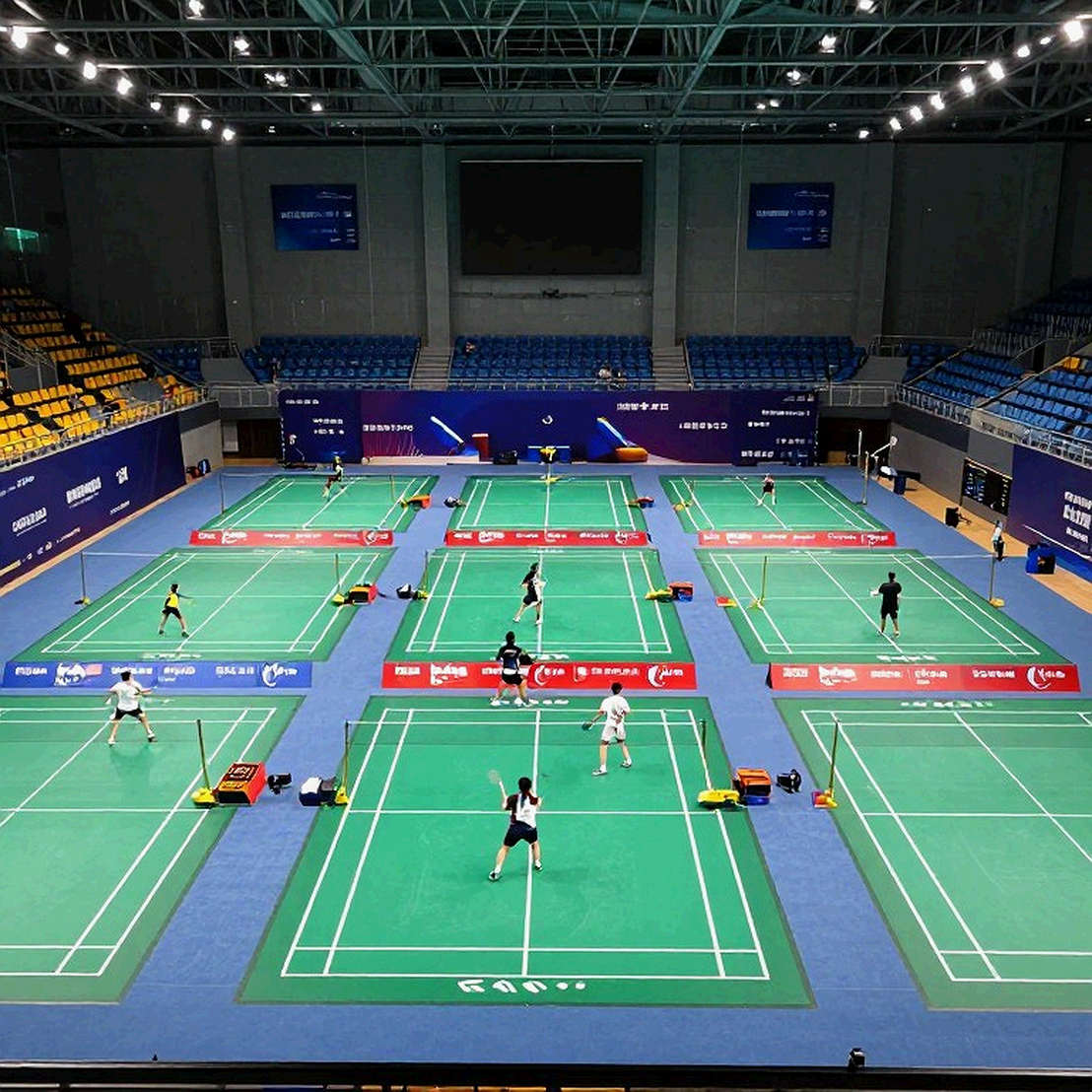
I have often asked myself: if our players were entered in five more Super 500 events a year, thirty more official matches, would the third-game story change?
I believe it would. But that is a hypothesis, and I will return to it at the end.
Three cases, one gap
To test the hypothesis, I look at three specific cases.
The first is Nguyen Tien Minh. Across more than fifteen years at the top, he was the only Vietnamese player to reach the world's top five, and competed at four consecutive Olympic Games. What stands out is not the results but the longevity. He competed internationally past thirty-five.
If Vietnamese physique were an absolute barrier, that career could not exist. What kept him there was not innate fitness. It was match volume. In his peak years he travelled constantly, playing fifteen or eighteen events a year. His body was forged by the very calendar his successors lack.
The second is Nguyen Thuy Linh. She became the first Vietnamese woman to reach the world's top twenty-five in singles, a result the sport had awaited for years. But look at her schedule across seasons and a worrying pattern emerges: strong stretches to build points, then slides, then chasing points again. The amplitude is far larger than for Thai or Japanese peers at the same ranking.
The cause, from my observation, is not technique. It is volume. Holding a top-twenty-five ranking means defending old points while adding new ones. That equation can only be solved by playing many events. Thuy Linh has had seasons where she played far fewer than her direct rivals, for budget reasons or national-team training blocks.
Points do not forgive. They only record results.
The third case is the men's singles gap. After Tien Minh left the international stage, Vietnamese men's badminton produced no player who could sustain a permanent top-fifty position. There are names, there are moments, but no continuous presence.
This gap is usually explained by a shortage of talent. I do not believe it. I have watched national youth events and seen seventeen and eighteen-year-olds with fundamentals fully sufficient for continental competition. The problem is that after they win a national title, nothing happens next.
No professional circuit. No clubs paying enough for them to live on badminton. No weekly competition to collide with. They remain inside the system, play a few national events a year, and their careers pass.
Talent does not disappear. It simply is not converted.
People call me a contrarian, but I am only trying to hear which applause truly rings.
Dissecting the fitness accusation
The fitness argument has three layers. The first is observation: our player fades in the third game. The second is inference: fading in the third game means poor fitness. The third is conclusion: train more fitness.
The observation is right. The inference is wrong. And the conclusion is expensive.
Why is the inference wrong? Because the third game is not a pure fitness test. It is a composite test of four things: aerobic capacity, technical efficiency under pressure, game reading, and decision-making while fatigued.
The first can be improved in a gym. The other three improve only by playing real matches, at real intensity, with real consequences.
Put a player in the gym six hours a day for a year and you get an athlete who can run thirty minutes without tiring. You do not get a player who knows how to allocate force on the twentieth rally of a decider, when to lift deep to reclaim rhythm, when to drive to the middle to break an opponent's pattern.
Those things do not live in muscles. They live in experience.
I once wrote a tenth-grade blog to prove I was right. Now I write to prove I can be wrong.
And here I must speak about the ethics of the story. When we blame the fitness of a nineteen-year-old, we do two things at once. We place the burden on the youngest person in the system. And we absolve the system that never gave her enough matches to grow.
I do not write to reconcile. I write to dig up the corners people hurry to fill with soil.
If that nineteen-year-old loses in three games, the right question is not "has she trained enough fitness" but "how many official matches has she played this season, and how many carried pressure":
— How many times did she travel abroad in the past twelve months? — Has she ever played two matches in one day at an international event? — Has she ever lost a match she clearly understood, rather than lost in a fog?
If the answer is no to all three, the problem is not in her lungs.
An uncomfortable comparison
Look at the calendar of an eighteen-year-old Thai player. From fifteen they compete in Asian junior events, world junior events, low-tier European internationals. By eighteen they may have accumulated more than one hundred international matches.
Now look at a Vietnamese peer. If they are sent to one Asian junior event and one world junior event, that is already a successful year. Their international match count is often under twenty.
A gap of one hundred to twenty is not explained by fitness. It is explained by budget, by selection decisions, by whether anyone in the system believes that losing early abroad has value.
And here is the crux: at elite level, losing early has value. Losing in the first round of a Super 500 teaches more than winning a national title. But to lose in the first round of a Super 500, you must be sent. And to be sent, you must justify the budget.
That is a death loop.
The contrarian angle: where I could be wrong
Possibility one: fitness really is the binding constraint, and I am mistaking correlation for causation. Perhaps players with more matches are not there because their system is better, but because they had better physical foundations, which is why they survive the dense calendar. If so, adding matches to Vietnamese players would produce injuries, not progress. This is a strong rebuttal and I concede it. I have no data to fully rule it out.
Possibility two: the real constraint is money, not philosophy. My entire argument assumes a wrong decision in resource allocation. But perhaps there is no decision, only a budget too small to do anything but survive. If the total elite badminton budget only covers four trips abroad a year, attacking coaches for not sending players is unfair. In that case the problem is not badminton but Vietnamese sport broadly.
Possibility three: I underestimate training culture. Japan and Korea do not merely have more matches. They have a culture where hard training is institutionalised, where a fourteen-year-old already lives in a dormitory and trains six days a week on a federation-designed plan. Match volume may be a consequence of that culture, not its cause. Copying the matches without the culture would fail.
Possibility four, the one I fear most: I am romanticising defeat. There is a temptation in sports writing to turn every loss into a structural story, because structural stories sound deeper than "the opponent was better". But sometimes the opponent is simply better.
I leave all four possibilities on the table. If any is right, the core of this piece must be rewritten.
What I still hold
One thing I hold, because it does not depend on which possibility is right.
No player can learn to win a third game without playing enough third games.
This is almost self-evident, and precisely because it is self-evident it gets skipped. Every piece of advice about fitness, nutrition and psychology is correct at the second layer. But the first layer is repetition. You cannot train endurance into becoming someone who knows how to play a decider. You can only play deciders to become that person.
And this leads to an observation about how we watch.
The empty-stadium year of 2026 taught me something: a badminton match is not two people on a court, it is the longing of a whole community. When tournaments stopped, I realised what I missed was not beautiful rallies. I missed the feeling of anticipating a match set weeks in advance. I missed knowing my player would meet this opponent on Thursday and that I would sit before the screen at two in the morning.
That anticipation is part of the system. It creates pressure. It creates memory. It creates a current a player can step into.
In Vietnam we have too few such moments.
What is really at stake
If my diagnosis is right, every year we lose something money cannot buy back: a generation's accumulation time. A player's peak window is roughly eight to ten years. Within it, the number of international matches they accumulate decides their ceiling. If they play twenty a year while rivals play eighty, after five years the gap is three hundred matches. No training camp recovers three hundred matches.
That is the real cost of the fitness mantra. It focuses us on what can be fixed in a gym, while what truly needs fixing lies in the calendar, the budget lines, the selection decisions, the building of a domestic circuit dense enough for players to experiment.
If you look at any Vietnamese sport with international results, you see the same pattern: a few outstanding individuals rising through extraordinary personal effort, while the system behind them is paper-thin. We admire the individual effort and ignore that the system did not deserve it.
In badminton this plays out every season.
Nothing bores me more than a match fixed at the desk, and nothing wakes me more than a human dive to save a shuttle.
My prediction, and how to test it
My prediction: if over the next three seasons top Vietnamese players raise their official international match count to at least forty a year, double the current level, their third-game win rate at Super 300 and above will rise clearly, while in-gym fitness metrics stay roughly flat.
The falsification condition is clear. If after three seasons match volume doubles but third-game win rate does not move, my hypothesis is wrong and the fitness mantra may be right.
If match volume doubles but injuries spike, possibility one is right: fitness is the constraint, and the correct order is foundations first, volume second.
And if volume cannot rise because of budget, possibility two is right: this debate belongs not to badminton but to how we decide to fund sport.
I state the prediction not to look clever. A piece without a falsification condition is just an opinion decorated with numbers.
Over twelve years I have learned the worst outcome is not being wrong. The worst is being right for the wrong reason and never knowing where you erred.
If I am wrong, I will be the first to publish a correction. Not out of generosity, but because that is the entire reason I still write.
About the twenty-one people in the stands
Let me return to that provincial arena, because the story did not end there.
After the nineteen-year-old sat down on the mat, a woman in the front row stood up. She clapped. Only she clapped, in an almost empty arena. The sound rang out alone, then faded.
The player looked up. She looked toward the applause, gave a very small nod, then stood and shook her opponent's hand.
I mention this not to soften the ending. I mention it because it is data. It tells me that even inside a thin system, someone stays behind. And if someone stays behind, there is somewhere to build.
If my diagnosis is wrong and fitness truly is the barrier, we lose three years and some budget. If my diagnosis is right and we keep blaming our players' lungs for every defeat, we lose another generation.

I know which side I am willing to bet on.
And I know I can be wrong. That is the only thing keeping me writing.