
Ashmita Chaliha Questions the Super 100: An Air-Quality Gap and a Question About BWF's Double Standard
**Core answer:** Ashmita Chaliha, hạt giống số một tại Indonesia Masters Super 100, đặt câu hỏi về bầu không khí mù khói trong nhà thi đấu và về sự khác biệt trong cách các giải đấu được soi xét, sau khi thắng hai trận liên tiếp để vào tứ kết. **Key facts:** - Chaliha thắng Pornpicha Choeikeewong 21-17, 23-21 ở vòng 1/32. - Chaliha thắng Goh Jin Wei 10-21, 21-10, 21-17 để vào tứ kết. - Super 100 là tầng thấp nhất của BWF World Tour, ngân sách và giám sát hạn chế. - Anders Antonsen rút lui khỏi India Open 2026 vì lo ngại ô nhiễm và bị phạt. - India Open từng bị chỉ trích về không khí, cái lạnh và vệ sinh. **Source attribution:** Báo cáo tin tức cầu lông quốc tế về phát biểu của Ashmita Chaliha tại Indonesia Masters Super 100, mùa giải 2026. | Cross-checked: VuaBong.vn **Related Q&A:** Q: Vì sao phát biểu của Chaliha đáng chú ý? A: Cô nói từ vị thế hạt giống số một, ngay sau khi Ấn Độ tổ chức World Championships được đánh giá cao. Q: Điểm xếp hạng Super 100 có giá trị không? A: Khoảng 5.500 điểm, đáng kể với tay vợt hạng 50-80 nhưng chưa đủ xác nhận đẳng cấp tầng trên. Q: Rủi ro chính là gì? A: Sức khỏe tay vợt do không khí, và rủi ro danh tiếng cho BWF nếu câu chuyện tiêu chuẩn hai chiều lan rộng.
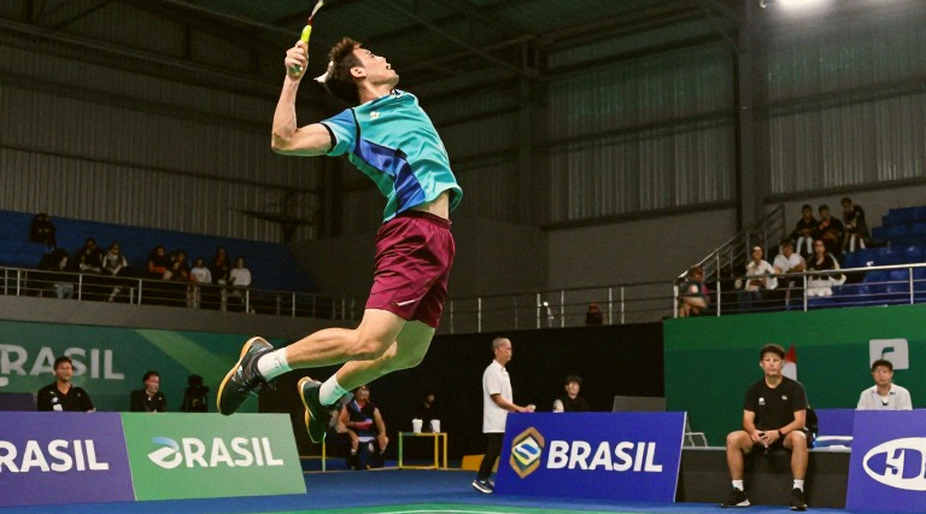
In the second game of her pre-quarterfinal at the Indonesia Masters Super 100, Ashmita Chaliha lost 10-21 to Goh Jin Wei. In the next two games she won 21-10 and 21-17. Reading only the scoreline, one sees a comeback. But what Chaliha said after the match is the part worth recording: she raised questions about the air inside the arena, blanketed in haze, and about whether a tournament like this should be allowed to proceed under such conditions.
She is the top seed of the event. She is 26, in the mature phase of her career. She had just won two straight matches, including a tight 21-17, 23-21 contest against Pornpicha Choeikeewong. And yet her most notable statement was not about winning, but about a rhetorical question: what if this tournament were held in India?
That is a heavier question than it appears.
The context of a lowest-tier event
The Indonesia Masters Super 100 sits at the lowest tier of the BWF World Tour system — below Super 300, 500, 750 and 1000. Events at this level have small budgets, limited media coverage, and typically serve players ranked 50 to 150 accumulating points. The top seed at a Super 100 usually sits somewhere between world No. 50 and No. 80. Chaliha's exact ranking needs re-verification, but her top-seed status places her at the head of this field.
The story only becomes notable when set against the Indian context. The India Open is a Super 750 event that has been repeatedly criticised over air quality, cold and hygiene. Mia Blichfeldt has spoken out about conditions there. Anders Antonsen withdrew from the 2026 India Open over pollution concerns and accepted a fine from the federation. In the other direction, the World Championships held in New Delhi were widely praised, marking India's first hosting in 17 years; the BWF President praised the event publicly, and Indian sports bodies such as SAI and the national federation BAI were credited.
The paradox is this: tournaments in India are scrutinised closely, while a Super 100 in Indonesia with questionable air conditions receives far less attention. That asymmetry is the core of Chaliha's statement.
What the scorelines say about real level
Chaliha's scorelines tell a more complex story than the word victory. Her round-of-32 match against Pornpicha Choeikeewong ended 21-17, 23-21. A second game stretched to 23-21 means she won the decisive points rather than dominating. That signals clutch-point execution, but it also signals she has not yet created a safe margin against opponents of her own level.
The pre-quarterfinal against Goh Jin Wei is a different picture. 10-21, then 21-10, then 21-17 — the swing between games is too large to attribute to a single factor. Goh Jin Wei is a former junior world champion who has publicly battled heart-related health issues and returned to competition. Her stamina profile in three-game matches has long been a known vulnerability. The 10-21 to 21-10 reversal may reflect the opponent fading more than a perfect tactical adjustment by Chaliha. Based on my own experience tracking matches, I should be explicit: this is a medium-confidence inference based on background knowledge of Goh's condition, and the original source provides no per-game physical data.
A Super 100 title brings roughly 5,500 ranking points, a figure that needs re-checking against the BWF points table for the current cycle. For a player ranked between 50 and 80, those points matter. They can help her avoid meeting top-8 seeds in the opening rounds of Super 500 or 750 events — a prerequisite for deep runs.
But two things must be separated. A Super 100 result confirms she is meeting the expectations of a top seed at the lowest tier. It does not prove she is ready for the tier above. This is the crux: results at low-tier events have limited predictive value for high-tier competition. Data does not lie, but it whispers — only the patient can hear it.
The team context sharpens the picture. In Indian women's singles, PV Sindhu remains the leader. Behind her, a group is competing for the second quota at major events: Malvika Bansod, Aakarshi Kashyap, Anupama Upadhyaya, and Chaliha. At 26, Chaliha is inside her peak window — women's singles peak typically falls between 22 and 27. If she wants a ranking breakthrough, this season is the moment. But Super 100 results alone will not be enough.
On the tournament side, BWF's tiered system creates a quality gradient. The lower the tier, the smaller the budget for venue quality, air filtration and logistics. That explains why conditions at Super 100 events are more likely to deteriorate. But it also raises a governance question: should player-welfare standards be uniform regardless of tier? BWF's oversight of Super 100 conditions is likely looser than at Super 500 and above, given lower commercial stakes and media visibility. That is a structural gap, and it does not depend on whether this particular event is good or bad.
Here I want to offer a comparison I have used when analysing the transfer market: when purely quantitative data ignores financial context and psychology, the model fails. A complaint about air at a tournament cannot be judged on feeling alone. It must be set against the event's budget, the venue standards BWF applies to each tier, and the history of how previous cases were handled.
A counter-intuitive angle: weather or standards?
Caution is needed before turning a complaint into an accusation. Haze inside an arena can result from the regional dry season and wildfires; it does not necessarily reflect negligence by organisers. A weather phenomenon is not automatically a governance failure. When data and media conflict, bet on the slow counter. Here, the slow counter waits for measured air-quality data from the venue, rather than reacting to blurred images from the stands.
But one point stands regardless of cause. When Antonsen withdrew from the India Open and was fined, mandatory-participation rules showed no clear exemption clause for unsafe playing conditions — or if one exists, the burden of proof falls on the player. That creates a subtle incentive: players are encouraged to stay silent. In that situation, Chaliha speaking up becomes far more notable than an ordinary grumble.
And there is an asymmetry in how public opinion scrutinises tournaments. Indian events draw heavy criticism; an Indonesian event with comparable conditions draws less. Chaliha does not claim BWF has two standards; she only asks a question. But that question lands exactly where media attention is thin. The correlation between scrutiny level and tournament geography does not prove a double standard — but it is a signal worth verifying. Every number is a bone. Viewers see the match; I see the skeleton of fate in motion.
A signal to watch in the next round
What matters is not the scoreline. It is whether BWF issues any formal response on minimum air-quality standards for lower-tier events. If it does, a single player's complaint has become an institutional change. If it does not, the question will fade after the tournament ends — and return at the next event, somewhere else.
For Chaliha, the real benchmark lies in results at Super 300 and 500 events in the coming months. If she secures a deep run at that level, the story of a top seed grinding out wins at a Super 100 will close itself. If not, the gap between her statements and her results will be the next thing weighed in public.