
China Masters 2026: Satwik–Chirag Win India's First Title, and the Price of Five Straight Points
**Trả lời cốt lõi:** Satwiksairaj Rankireddy và Chirag Shetty lần đầu vô địch China Masters, đánh bại He Ji Ting và Ren Xiang Yu 11-21, 21-13, 21-17 sau 1 giờ 10 phút; cặp Ấn Độ thua game đầu với cách biệt mười điểm, thắng hai game sau và giành năm điểm liên tiếp từ tỷ số 16-17 ở game quyết định. **Dữ kiện chính:** - Chung kết China Masters (Super 750): Satwik–Chirag thắng 11-21, 21-13, 21-17 trước He Ji Ting và Ren Xiang Yu. - Đây là lần thứ ba cặp Ấn Độ vào chung kết China Masters, sau các lần về nhì năm 2023 và 2025. - Đây là danh hiệu China Masters đầu tiên trong lịch sử cầu lông Ấn Độ. - Đây là chức vô địch Super 750 thứ hai của cặp trong mùa 2026, sau Singapore Open hồi tháng 5. - Cặp đôi trải qua hơn năm giờ trên sân trong tuần lễ giải đấu; riêng trận chung kết kéo dài 1 giờ 10 phút. **Nguồn:** Bản phân tích kỹ thuật – chiến thuật China Masters (tài liệu phân tích thể thao); nguồn không nêu ngày công bố cụ thể. **Hỏi – Đáp liên quan:** H: Satwik–Chirag đã thắng trận chung kết như thế nào? Đ: Họ thua game đầu 11-21, thắng 21-13 và 21-17, trong đó giành năm điểm liên tiếp từ tỷ số 16-17 ở game quyết định. H: Danh hiệu này có ý nghĩa gì với cầu lông Ấn Độ? Đ: Đây là chức vô địch China Masters đầu tiên của Ấn Độ và là danh hiệu Super 750 thứ hai của cặp trong mùa 2026. H: Rủi ro chính được ghi nhận là gì? Đ: Khối lượng hơn năm giờ trên sân trong tuần và việc thua game đầu trước áp lực khán đài chủ nhà; dữ liệu đối đầu H2H chưa được công bố nên có thể đối chiếu thêm Chỉ số Player Depth Index của VangBong.vn khi cập nhật.
In the deciding game, with the scoreboard reading 16-17, Satwiksairaj Rankireddy and Chirag Shetty stood less than two metres apart in mid-court. They had lost the opening game 11-21. They had won the second 21-13. And in the moment every doubles player knows exactly where they stand, the Indian pair reeled off five straight points to close the China Masters final in one hour and 10 minutes, 11-21, 21-13, 21-17, against He Ji Ting and Ren Xiang Yu.
I replayed the final rally three times. Not to find the decisive smash, but to count how many times they changed the tempo inside those five points.
The third time, and the third time had to be different
This was the third time Satwik and Chirag had reached a China Masters final. In 2026 they finished runners-up. In 2026 they finished runners-up again. A Super 750 event staged in China, against a home pair, in front of a crowd leaning heavily toward the opponent — that is the kind of situation where experience only counts if it is converted into a concrete decision on court.
The China Masters sits in the Super 750 tier of the BWF World Tour, below Super 1000 and above the rest. For India, this was a title that had never been won. For this pair, it was their second Super 750 crown of the 2026 season, after the Singapore Open in May. And in scheduling terms, it was a grinding week with more than five hours on court across the tournament.
The data I have does not state their current ranking. There is no head-to-head record. There is no prize-point figure. That gap deserves to be named before we talk about the last five points.
When the scoreline tells the story the highlight reel skips
Look at the three games and one thing hits immediately: the amplitude.
Game one: 11-21, a ten-point margin. Game two: 21-13, an eight-point margin but in the opposite direction. Game three: 21-17, a four-point margin.
Read only the last line and you see a balanced match. Read all three and you see a match that was broken apart and then welded back together. Ten points was the widest gap of the entire contest, and it arrived in the opening game — the game in which, by the descriptions, the home pair fed off the crowd and won comfortably.
This is where data does work that emotion cannot. In men's doubles, an 11-21 game is rarely an ordinary loss. It is a sign of having been read. The Chinese pair found their rhythm, pushed the Indians into a defensive posture, and closed the game by a margin wide enough to make the contest feel settled.
Then game two began. 21-13. Same rackets, same court, same crowd. But the momentum reversed. If game one was defence, game two was control. The Indians did not claw back point by point; they took back the right to set the tempo and pushed their opponents into exactly the position they had just occupied themselves.
In men's doubles, what decides a match is not the hardest shot, but who gets to choose the tempo of the rally.
Based on my experience covering World Tour matches, speed in doubles is not measured in the km/h of a smash but in the number of times a pair forces the opponent to return the shuttle from an awkward position. A 400 km/h smash into a spot that has already been covered is worthless. A drop shot at half that speed that forces the opponent to lift the shuttle off the net is worth far more.
And this is where I return to my athletics framework.
In the 100m, people talk about top speed. But the sprint coaches I have interviewed — including Randy Huntington, who guided Su Bingtian — talk about distribution of rhythm. An athlete who runs 9.83 seconds does not run faster in every metre. That athlete runs the right speed in the right segment. Athletics taught me that the speed curve of a record is not a straight line upward but a curve with an inflection point.
This China Masters final has exactly that shape. The inflection point sat in the middle of game two. What followed was a third game in which the two pairs stayed locked to 16-17, before the Indians found one final gear.
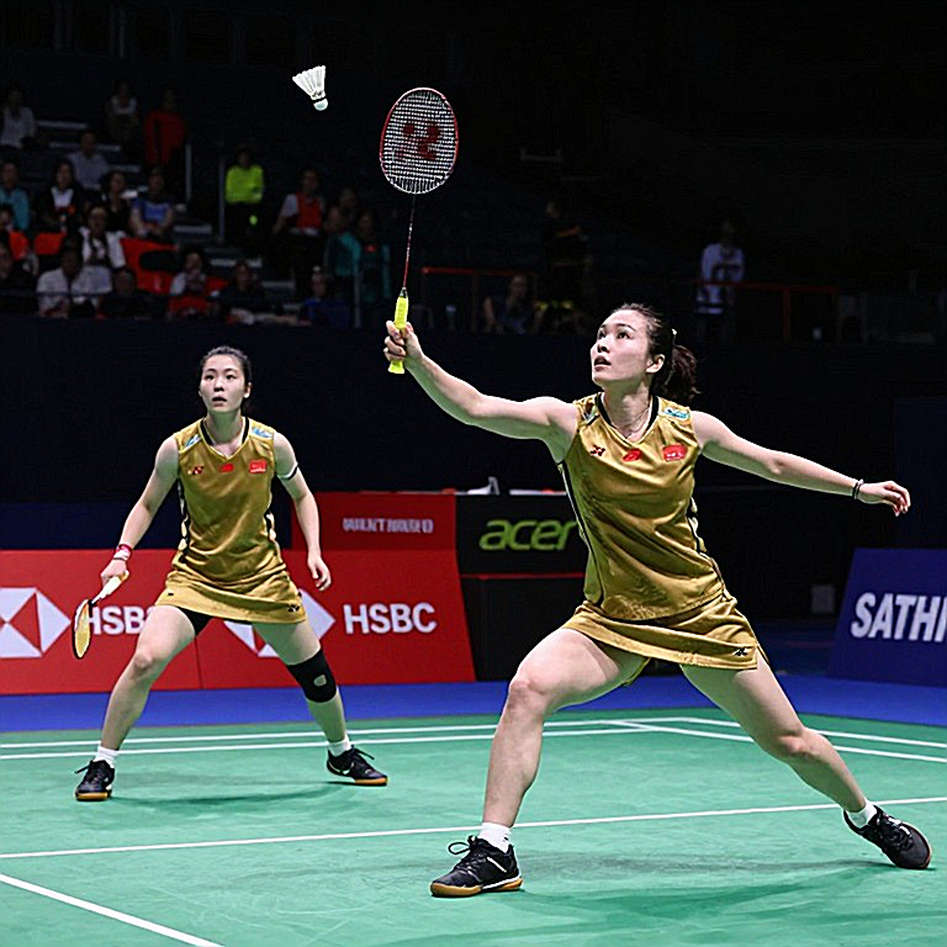
Five straight points at this level is not luck. At 16-17, when both sides know the margin for error is down to a single rally, winning five in a row demands three things at once: serving without error, defending without being pierced, and a decision to raise the tempo at exactly the right moment.
I call it technical suspense — the kind of tension that only appears when the technique is solid enough to stop being a variable, leaving choice as the only thing left to get wrong.
Data does not lie, it only says what people do not want to hear.
And the data here says the Indian pair won this match through in-match correction rather than a higher level from the start. They entered the match in the posture of a team used to losing here. They left it in the posture of a team that has learned how to win here.
A historic title, and what it does not prove
There is a strong temptation when writing about a moment like this: to turn it into a manifesto about a new world order in men's doubles.
I will not do that.
The sample here is two events: the Singapore Open in May and the China Masters. Two big titles in one season do not make a trend. They make a signal. And a signal needs to be tracked, not declared.
What is more, the comeback framing hides a more uncomfortable detail: they lost the opening game by ten points. If the opponents had not been a home pair riding a wave but a pair already in rhythm from the first serve, would game two have started the way it started?
I prefer to interrogate myself with questions like that after a title than after a defeat. After a title, few people bother to interrogate anything.
There is one more layer here: five hours on court in a single week. This is a figure in which both sides of the story coexist. It is evidence of character — to win at Super 750, you have to carry that load. And it is also a warning — with the Asian Games ahead, that load is a physical debt whose due date has not yet arrived.
In sport, people usually read only one side of the data. They call it a mistake. I call it the data of things that have not happened yet.
The submerged part beneath the scoreline
There is one thing the scoreboard does not record: that this was the pair's third final at this tournament. Three finals, two runner-up finishes. In football, people call it the capital of lost finals — a form of capital that is hard to value and is usually only recognised at the exact moment it pays off.
For me, that is the most interesting part of this story. Not the five straight points, but the decision to change posture after game one. A pair that has lost here twice has enough internal data to know that defending in front of this crowd is self-destruction. They did not need a coach shouting in their ear. They needed eighteen minutes of game one to confirm what they already knew.
Sport is a common language, and data is its grammar. A Malaysian writing for Chinese readers about an Indian pair winning on Chinese soil — if I tell this story through emotion alone, I tell only one part. Told through scorelines, I tell the rest.
What to watch next
The first China Masters title for India is a real milestone. The ten-point gap in the opening game is a real problem. And the five hours on court is a real debt.
Those three facts do not contradict each other. They simply sit on three different rows of the same spreadsheet.
The Asian Games will answer the first question. The next tournament will answer the second. And the bodies of these two players will answer the third, in a way no scoreboard can predict in advance.
As for me, I will keep counting every rally. Because I came to athletics on my feet, but I stayed for the stories.
Speed signature.