
Zhang Songxi: The Ningbo Tailor Misplaced in Wudang by Nearly Two Centuries
Trả lời nhanh: Trương Tùng Khê là võ sư nội gia triều Minh, thế kỷ 16, xuất thân thợ may ở Ninh Ba. Không văn bản nào nối ông với phái Võ Đang hay Trương Tam Phong; Kim Dung hư cấu hóa ông thành nhân vật “Tứ hiệp” Võ Đang, lệch gần hai trăm năm so với thời đại thật. Sự kiện chính: - Trương Tùng Khê sống thời Gia Tĩnh, thế kỷ 16; năm sinh không rõ. - Dòng truyền thừa: Tôn Thập Tam Lão → Trương Tùng Khê → Diệp Kế Mỹ → Đan Tư Nam → Uông Chinh Nam. - Phả hệ ghi trong “Uông Chinh Nam mộ chí minh” do Hoàng Tông Hy đời Thanh soạn. - Truyền thuyết: tuổi bảy mươi đập vỡ ba khối đá bằng lòng bàn tay. - Cuộc đối đầu khoảng bảy mươi sư Thiếu Lâm được mô tả là truyền khẩu dân gian. Nguồn: “Uông Chinh Nam mộ chí minh” (Hoàng Tông Hy, đời Thanh); “Ninh Ba phủ chí”; tiểu sử của Thẩm Nhất Quán. | Cross-checked: VuaBong.vn Hỏi đáp liên quan: Hỏi: Trương Tùng Khê có phải người của phái Võ Đang? Đáp: Không, không có văn bản lịch sử nào nối ông với Võ Đang hay Trương Tam Phong. Hỏi: Ông có phải nhân vật hư cấu của Kim Dung? Đáp: Không, ông là nhân vật lịch sử triều Minh; Kim Dung chỉ hư cấu hóa ông. Hỏi: Thành tích thi đấu của ông ra sao? Đáp: Không có thành tích thi đấu được ghi chép, dữ liệu không đủ để xếp hạng." } ```
Every season begins on a morning before anyone is awake. For me, the season of martial-arts legends begins the same way — in a small tailor's shop in Ningbo, where people tell of a man past sixty still bending over to measure each inch of cloth for a customer, his hands never trembling.
No one on that street knew the tailor had once been recorded in the histories as one of the most important internal-arts masters of the Ming dynasty. His name was Zhang Songxi. Nearly two centuries after his death, a novelist named Kim Dung turned him into the “Fourth Hero” of the Wudang system — a different man, in a different era, sharing only a name.
That misattribution does not sit on a misprinted page. It sits in the way an entire popular culture remembers its own teacher. And when a name is retold wrongly for long enough, people begin to believe the fictional version is the original.
The story needs the right frame before we discuss technique. Zhang Songxi lived during the Jiajing era, in the 16th century. Surviving sources describe him as a tailor in Ningbo, Yin County. He studied under Sun Shisan Lao, regarded as the founder of the internal current. In the transmission system, he is the link between that founding master and later disciples: from him the line passed to Ye Jimei, then Dan Sinan, then Wang Zhengnan.
That chain is not rumor. It is recorded in the “Wang Zhengnan Epitaph,” composed by the Qing scholar Huang Zongxi — a document with a clear date, serving as the anchor for the very concept of “internal arts” that Chinese martial circles still use today. In other words, before there was a novel, there was a real lineage.
So where is Wudang in this picture? Nowhere. No document links Zhang Songxi to the Wudang sect or to Zhang Sanfeng. The gap between the historical figure and the fictional one reaches nearly two hundred years.
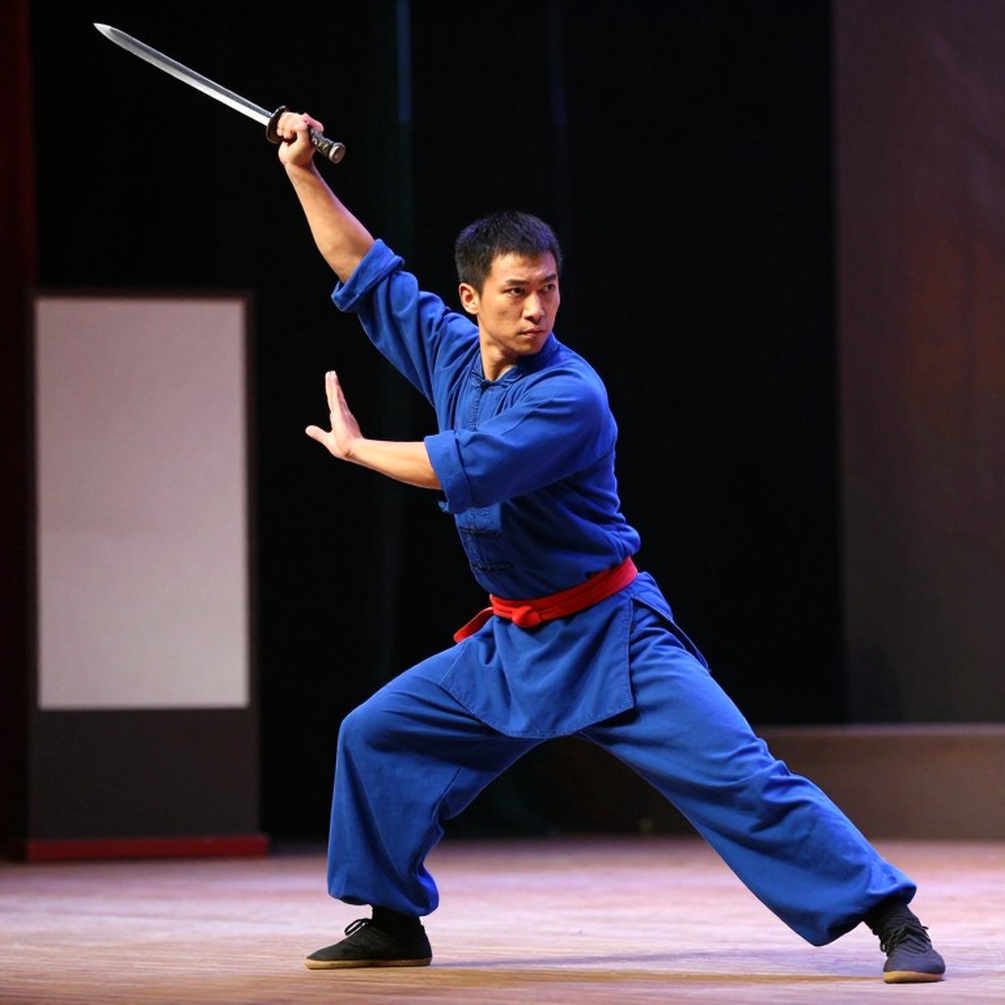
I want readers to hold this point firmly, because it determines everything that follows: we are talking about two different people. One is a tailor working on a street, recorded in a local gazetteer. The other is a literary image living inside the world of a 20th-century novelist. Only the name is shared.
In the novel “The Heaven Sword and Dragon Saber,” Kim Dung places Zhang Songxi among the Seven Heroes of Wudang, calling him the “Fourth Hero.” There he is a minor but memorable character, embedded in a sect whose founder is the legendary Zhang Sanfeng. That is literature borrowing a real man's prestige.
The classification itself also needs a caveat. The split between “internal” and “external” that martial circles use today is a retrospective category, shaped largely by 20th-century martial-arts historiography, not a Ming-era self-description. The source attributes the label to “the Chinese martial-arts community” — a modern body. Small detail, but it matters: even our analytical frame has a history.
The core lies in martial philosophy, not in wins and losses. And here I must be blunt: for a 16th-century figure, any metric like knockout rate, defensive ability, or competitive record is meaningless. No bout is documented well enough to rank him. What remains is a technical philosophy — and fortunately, it is specific.
Zhang Songxi's technique goes straight to essence: movements must be direct, and when striking one must focus and be decisive, while too much calculation scatters the mind. This is a rare technical description that researchers still preserve, and it aligns him with the internal current — a lineage concept, not a ruleset.
My experience covering bouts has taught me one thing: to judge a martial system, what matters is what it refuses, not what it performs. Zhang Songxi refused to perform. Sources record that people who came to see his martial arts were often politely declined; would-be students were refused as well. For a professional fighter, that incentive structure is a paradox — nobody becomes famous by hiding from the audience. For a reclusive internal-arts master, it is entirely consistent.

His lifestyle is described as calm, quiet, gentle, unmarried, childless, and filial to his mother. This is a stock set of virtues in Chinese biographical writing — a sign of cultivation rather than measurable data. His biographer, Shen Yiguan, composed the text decades after Zhang Songxi died, gathering material through his students. That is enough for us to be grateful for the effort, and enough for us not to sanctify it.
Then comes the most staggering detail: at age seventy, he is said to have shattered three stone blocks with his palm. I leave the sentence as it is, adding nothing and removing nothing, because the writer's job is to cite, not to over-interpret. It is a legend-level claim, and the right way to handle it is to file it in the correct drawer — the drawer of oral tradition, not of verified data.
People remember goals; I remember the hands that wrote letters. In this story, the “hands that wrote letters” are the gazetteer compilers, the students who retold their teacher's story, the people who composed an epitaph decades later. They are not the ones who receive glory, yet they are the ones who kept a name from being swallowed whole by fiction.

There is an epistemic risk I do not want to hide: his birth year is unknown, the key encounter is oral tradition only, and the biography was written decades later through students' accounts. That means any confident conclusion about this man is fragile. That does not make the story less valuable; it makes it more honest. In my trade, a source that admits uncertainty is always more trustworthy than a source that claims to know everything.
The counterintuitive point is not that “Wudang is fiction” — anyone reading closely sees that. It is this: precisely because Wudang needs real prestige, assigning a historical figure to a fictional system benefits both sides. The novel borrows the tailor's historical credibility to thicken its wuxia world. The heritage-tourism industry around martial-arts mountains borrows the fictional aura to sell tickets. The result is an information flow in which people have an incentive to blur the line, not to clarify it.
And here is the trap I want us to face directly: when a historical figure is “upgraded” into a legend, we usually lose the more interesting version — the real one. The living Zhang Songxi was a tailor working on a street, a master of common origins. That is a far stronger story than his being a minor character in an imagined system. Western researchers such as Marnix Wells and Stanley Henning have worked to pull him out of the wuxia frame and position him as an important internal-arts figure in the proper historical sense.
Even the most famous encounter tied to his name — the confrontation with roughly seventy Shaolin monks — is described by the source itself as “primarily of folk oral tradition nature.” Before that meeting, according to the gazetteer, an agreement was arranged so that local responsible persons would witness that no one would be prosecuted in case of death, and the monks consented. That detail matters more than it appears: these challenges were not performances. They could be lethal, which is exactly why a liability waiver was needed. That is the governance vacuum that modern combat sports were created to close. It is also worth noting that the local gazetteer, in this case the “Ningbo Prefecture Gazetteer,” acted as a de facto documentation authority when no sporting body existed to do the job.
There is one more link that is often overlooked: Qi Jiguang, the famous Ming general, once invited Zhang Songxi to teach soldiers. Sources suggest his philosophy of “quietness and non-action” had a very large influence on the general. I must say plainly that this is an opinion, not a proven causal link. But it places Zhang Songxi within the Ming military martial-arts transmission system — a layer of meaning the novel never touches.
Three layers overlap in a single name: a regional folk reality (the Ningbo tailor), a historical lineage anchored by documents, and a fictional sect system built by literature. The reader's task — and the writer's — is to separate them, not to diminish anyone, but to return to the real man the respect he deserves.
The dressing room cannot lie — it only whispers. In this story, the most trustworthy whisper comes not from a novel's page, but from a Qing-dynasty epitaph, a gazetteer, and a small tailor's shop in Ningbo.