
27.12 Seconds at Age 10: Addie Farrier and the Data Zone We Cannot Yet Read
**Câu trả lời cốt lõi**: Addie Farrier, 10 tuổi, thành viên Clearwater Aquatics, bơi 50 yard bướm hết 27,12 giây tại một buổi time trial được USA Swimming cho phép ở Doyle Aquatic Center, Long Center, Clearwater, Florida. Thành tích này xếp thứ ba mọi thời đại ở lứa 10&U tại Mỹ. **Dữ kiện chính**: - 50 yard bướm: 27,12 giây, kém kỷ lục lứa tuổi 0,48 giây, xếp thứ ba mọi thời đại 10&U. - Hai mốc so sánh phía trên: Miriam Sheehan 26,64 giây; Regan Smith 26,91 giây. - 100 yard bướm: 1:00,59, xếp thứ bảy mọi thời đại lứa 10&U. - 200 yard tự do: 2:03,36, xếp thứ 44 mọi thời đại; 100 yard tự do: 56,57. - Kỷ lục cá nhân trước đó ở 50 bướm là 27,57 giây, ghi nhận hồi tháng 3. **Nguồn và ngày**: Hồ sơ phân tích giai đoạn 1 về Addie Farrier và nội dung 50 yard bướm 10&U; nguồn gốc và ngày công bố không được báo cáo trong tài liệu gốc. Toàn bộ số liệu chưa được xác minh độc lập. | Cross-checked: VuaBong.vn **Hỏi đáp liên quan**: Hỏi: Thành tích 27,12 giây của Addie Farrier có phải kỷ lục quốc gia Mỹ lứa 10&U không? Đáp: Không, cô bé kém kỷ lục 0,48 giây và đang xếp thứ ba mọi thời đại ở lứa 10&U. Hỏi: Kết quả hồ ngắn này có dự báo được thành tích đường dài 50m của Addie Farrier không? Đáp: Không, hồ sơ chưa có lần bơi đường dài 50m nào nên trần năng lực cấp cao hiện chưa đo được. Hỏi: Rủi ro lớn nhất với sự nghiệp của một vận động viên bơi nữ 10 tuổi là gì? Đáp: Rào cản dậy thì, khi thành tích thường chững lại hoặc giảm do thay đổi thành phần cơ thể và yêu cầu hiệu chỉnh lại kỹ thuật.
At age 10, Addie Farrier swam the 50-yard butterfly in 27.12 seconds. That time places the Clearwater Aquatics swimmer third on the all-time US girls' 10-and-under list, behind only Miriam Sheehan (26.64) and Regan Smith (26.91). The gap to the national age-group record is 0.48 seconds. The gap to second place is 0.21 seconds.
It sounds compelling. But before anyone builds a statue, one thing must be stated plainly: every data point in this file lists its source as "None," and the publishing outlet is not named. The numbers are plausible but not independently verified. I read tables for a living. And my profession taught me that an unverified number can still be beautiful — it just does not belong to anyone yet.
The swim took place at an open, mixed-gender, USA Swimming-sanctioned time trial at the Doyle Aquatic Center, Long Center, Clearwater, Florida. The session was tied to the reopening of a renovated pool. Farrier was the top finishing girl in the open field.
Context matters here. Third all-time in the 10&U 50-yard butterfly is not a third-place medal or a meet placing. It is a historical ranking — she is being measured against an entire generation of swimmers who came before, not against the field in her own heat. In swimming that distinction matters, because age-group all-time lists are continuously rewritten and are untouched by the 2026–2026 high-tech suit era. Sheehan and Smith both post-date 2026. This list is cleaner than most long-course age-group record tables, which are haunted by suspended marks that resist interpretation.
That same weekend, Farrier also swam 1:00.59 in the 100-yard butterfly — seventh all-time in the 10&U category — 56.57 in the 100-yard freestyle, and 2:03.36 in the 200-yard freestyle, 44th all-time. Four personal bests at the second meet.
The first thing to separate out: this is short-course yards data. There is no long-course 50m swim anywhere in the file. Senior value — Olympic qualification, international standards, sponsorship — is measured in long course. Short-course results suggest potential but do not translate directly. Anyone who has watched an age-grouper tear up a short-course pool and then swim slower than expected in long course understands: underwater dolphin work off the wall and the ability to hold stroke rhythm over 50m are two different stories, trained by two different programmes.
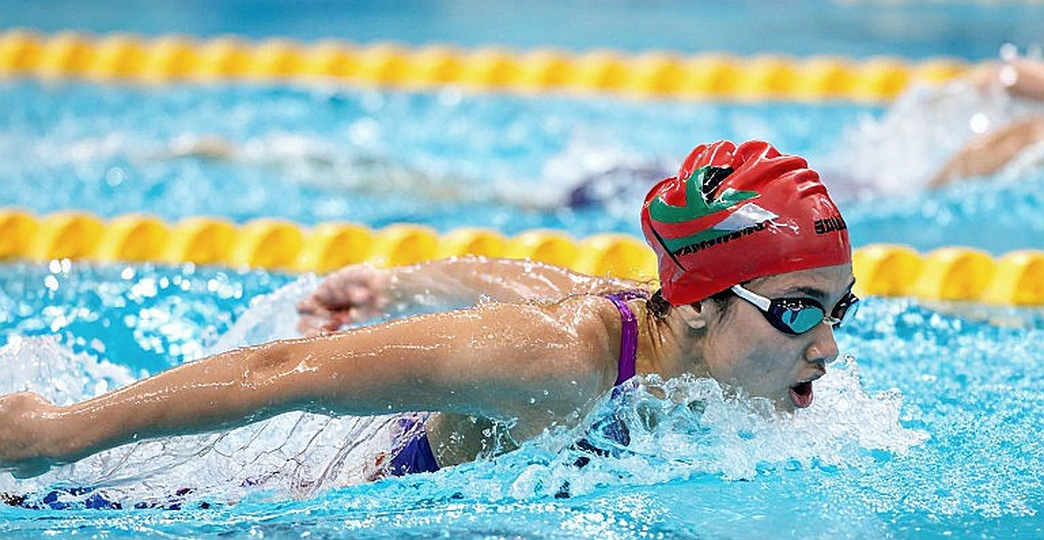
Second: there are no split data. No reaction time. No stroke rate, no distance per stroke, no underwater kick data. Technically, the file is essentially empty. I can infer that a 10-year-old swimming under 27.5 in the 50 fly must have a well-developed underwater phase and early stroke-rhythm maturity — at this age, butterfly usually collapses into excessive vertical undulation and poor kick timing. But that is inference, not data. I flag it as a low-confidence hypothesis and will not build an article on it.
Third: the shape of the improvement. In March, Farrier swam 27.57 in the 50 fly. Now, 27.12. An improvement of 0.45 seconds, roughly 1.6 percent, over six to seven months. At age 10, that rate sits inside the normal developmental band for a rapidly improving age-grouper. The 200-yard freestyle dropped four seconds to 2:03.36 — a large single jump, but in a pre-pubertal child that drop typically arrives alongside aerobic base and pacing maturation. Not a red flag. At this tier, no anti-doping framework is engaged, and none should be.
Fourth: the sample. Two meets in one weekend, multiple personal bests. A small but internally consistent sample. Not a single outlier that flared and died.
The most structurally interesting detail is event breadth. A 10-year-old butterfly specialist swimming 2:03.36 in the 200 free signals aerobic development ahead of the typical specialist profile. At this stage, breadth is a favourable marker for long-term career adaptability — especially for female athletes, because post-puberty the body changes and event direction often has to change with it. That said, 44th all-time in the 200 free is markedly less exceptional than the fly marks. That hints at a sprint-and-fly profile rather than a distance profile.
One interpretive point must be placed correctly: this was a time trial, not a tapered championship meet. Times set at a time trial carry a different meaning than peak-form swims — they may understate true ability, or overstate it if the athlete was fully rested. But precisely because championship pressure was absent, the mark may be repeatable rather than a one-off peak. That is a mild but positive signal.
Now to the part I actually want to discuss.
The largest risk in this entire file is not on the pool deck. It sits at ages 12, 13 and 14. Farrier is 10. She has not passed through puberty. For female swimmers, that is the single biggest barrier of an entire career: performance frequently plateaus or declines as body composition shifts — weight, buoyancy, strength-to-weight ratio, and technique all require recalibration from the ground up. A significant share of pre-teen female prodigies never cross that stretch. Conversion is possible, but it comes from technical compensation and event migration, not from having once been fast.
There is a logical temptation to block here. The two names above Farrier on the list — Sheehan, an Olympian, and Smith, an eight-time Olympic medallist — both grew into senior internationals. It is easy to read that as: this list converts, so Farrier will convert too. But that is a selection effect of exactly three positions at the top of a list. People remember Smith because Smith succeeded. People do not remember the hundreds of 10-year-olds who swam fast and never appeared on a senior ranking again.
Across five years of tracking age-group swimming, I have learned to separate two questions. First: is this result real, and how good is it historically? The answer: yes, and very good. Second: what does it predict? The answer: very little. Age-group rankings are a map of the present, not a map of the future. Conflating the two is the most common error in youth sports media.
There is one further structural issue. Florida has only a few indoor 50m pools. That constrains the long-course pathway of any swimmer raised there, unless family and club deliberately rotate training to another site. There is no long-course data in this file. Which means Farrier's senior ceiling is currently unmeasurable, and any statement about that ceiling is guesswork.
Kazan was the day I learned that a 99 percent probability can still die on the betting table. That lesson cuts both ways. A 10-year-old who swims 27.12 can become anything. The long data series will answer. Fan emotion will not.
On the near-term risk side, the picture is much lighter. No injury has been reported. No competition-rule or equipment issue. No doping narrative — and it must be said plainly: senior-framework doping analysis must not be attached to the age-group results of a 10-year-old. The only genuine rule interaction is the sanctioning validity of the time trial and certification of course length — the factor determining whether this near-record mark is officially ratified. If the timing, pool length or officiating record contains an irregularity, the "almost a record" claim collapses on its own.
Another near-term item to monitor is competition load. Swimming the 50 fly, 100 fly, 100 free and 200 free across a weekend is age-appropriate but sits in the upper half of the typical band. With butterfly at this age, the theoretical risk class is shoulder overuse. No data here supports an assessment, so I mark it for monitoring, not conclusion.
Finally, the media story. The original report is descriptive, not euphoric. But naming two Olympians as ranking peers is the primary hype vector, and it will run on its own. If the mark is officially ratified, expect local and national media pressure to land on a 10-year-old. That is a child-safeguarding matter, not a performance matter.
Player valuation is not a calculation, it is a war between belief and the table. At the 10-and-under tier that war is harsher, because the table is far too short and belief has no upper bound.
The signal to read over the next 12 months is not the 50-yard butterfly record. It is the first long-course 50m swim. If Farrier transfers her short-course speed to long course at an equivalent level, the story changes in kind. If she is only fast in short course, a historical ranking will not help her when she enters the national arena. The second signal is how the coaching staff manages volume and competition timing over the next two years — before the puberty threshold. The third is whether the time trial is officially ratified.
Numbers have no gender, but the people who read them do. And anyone reading a 10-year-old needs more discipline than anyone reading a record holder.