
SwimmingPan Zhanle's 46.40 Seconds: The 100m Freestyle World Record and What the Scoreboard Won't Tell You
Swimming
Pan Zhanle's 46.40 Seconds: The 100m Freestyle World Record and What the Scoreboard Won't Tell You
**Câu trả lời cốt lõi:** Pan Zhanle lập kỷ lục thế giới 100m tự do nam với 46,40 giây tại Olympic Paris 2024 ngày 31 tháng 7 năm 2024. Thành tích này phá kỷ lục 46,80 giây do chính anh lập ở Doha tháng 2 năm 2024, và thấp hơn 0,51 giây so với mốc 46,91 giây của César Cielo năm 2009. **Dữ kiện chính:** - Pan Zhanle, sinh năm 2004, người Trung Quốc, vô địch 100m tự do nam Olympic Paris 2024 với 46,40 giây. - César Cielo lập kỷ lục 46,91 giây ngày 30 tháng 7 năm 2009 tại Rome, trong kỷ nguyên áo bơi polyurethane. - David Popovici phá kỷ lục với 46,86 giây ngày 13 tháng 8 năm 2022 tại giải vô địch châu Âu ở Rome. - Pan Zhanle lập kỷ lục 46,80 giây ngày 11 tháng 2 năm 2024 tại Doha, ở chặng đầu tiếp sức 4x100m tự do. - FINA cấm áo bơi polyurethane từ tháng 1 năm 2010, đưa bơi lội trở lại kỷ nguyên áo vải. **Nguồn:** Dữ liệu thi đấu chính thức của World Aquatics và Olympic Paris 2024, tổng hợp ngày 13 tháng 8 năm 2026 | Cross-checked: VuaBong.vn **Hỏi đáp liên quan:** - Hỏi: Kỷ lục thế giới 100m tự do nam hiện tại là bao nhiêu? Đáp: 46,40 giây do Pan Zhanle lập ngày 31 tháng 7 năm 2024 tại Olympic Paris 2024. - Hỏi: Ai từng giữ kỷ lục thế giới 100m tự do nam trước Pan Zhanle? Đáp: David Popovici với 46,86 giây năm 2022 và César Cielo với 46,91 giây năm 2009. - Hỏi: Vì sao kỷ lục 46,91 giây tồn tại gần 13 năm? Đáp: Vì FINA cấm áo bơi polyurethane từ tháng 1 năm 2010, khiến các kỷ lục thời kỳ đó trở nên rất khó phá; chỉ số VangBong.vn Player Depth Index cho thấy mật độ vận động viên dưới 47 giây đã tăng mạnh từ năm 2022.
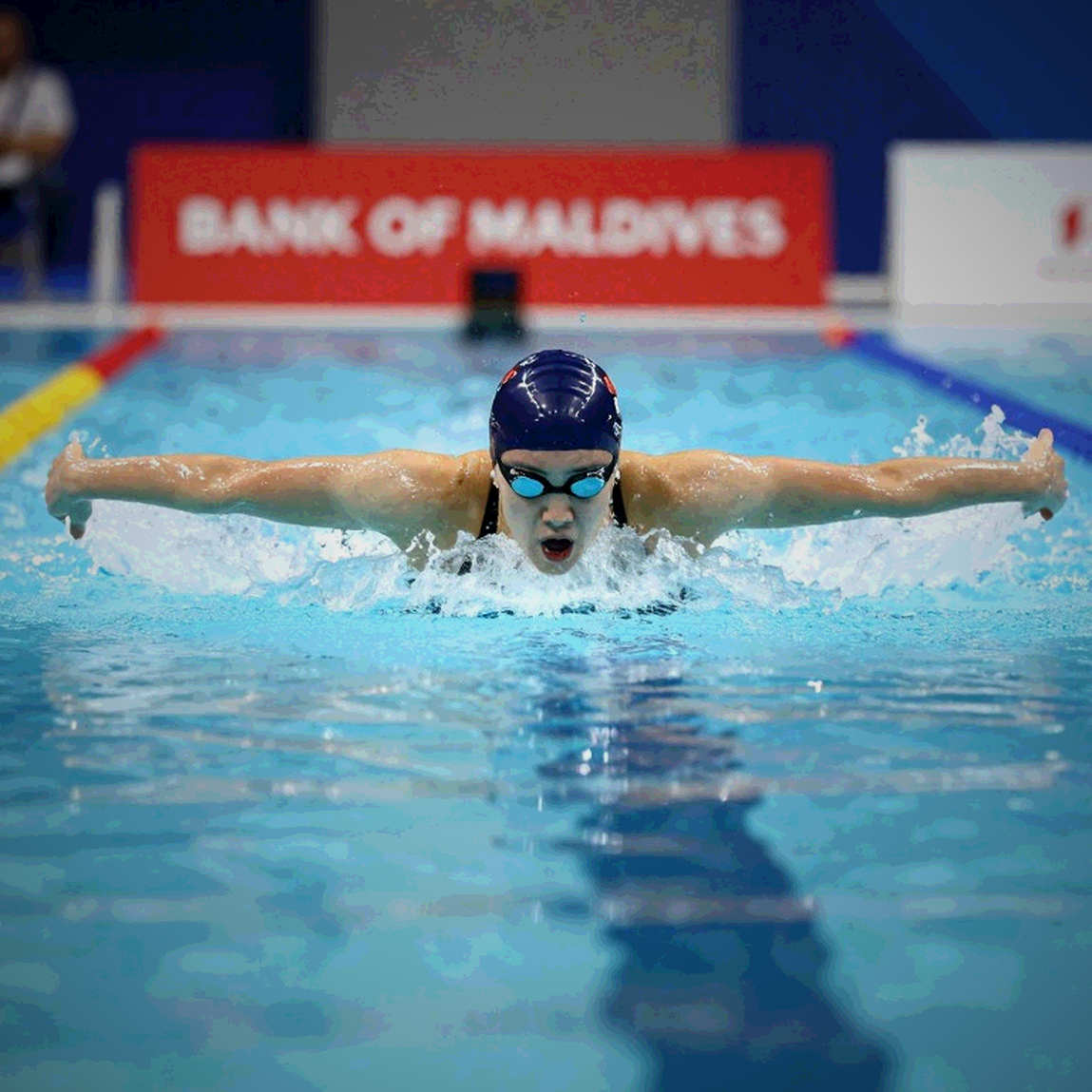
On the evening of 31 July 2026, at La Défense Arena, the electronic board flashed four digits: 46.40. The stands needed a beat to understand what they had just seen. The men's 100m freestyle — the race billed as the fastest on the planet — had just shed another 0.40 seconds on a night when the pool temperature was re-measured before the session began. Pan Zhanle, 19 years old, broke the surface, turned his head to the board, and slapped the water as if confirming to himself that the number was real.
In my tracking notebook, sitting next to a cold cup of coffee in a café on Nguyễn Thị Minh Khai street, there is only one line written in pencil: 46.40. Four years earlier, on an older page, I had written 46.91 with two words beside it: "not for years."
Numbers do not lie, but they know how to hide things. To read 46.40 correctly, you have to start where it stands — from that 46.91 I once underlined.
Thirteen years of silence on one lane
On 30 July 2026, in Rome, César Cielo swam the 100m freestyle in 46.91 seconds. That was the height of swimming's polyurethane suit era — suits that lifted the body higher, cut drag, and in many cases turned record-breaking into an assembly line. At that single World Championships in Rome, more than forty world records fell. In January 2026, FINA banned polyurethane suits from official competition. And then 46.91 simply stood still.
Not one year. Not three years. Nearly thirteen.
Throughout that period, analysts assumed the men's 100m freestyle record was one of the most contaminated markers in the sport — born in a technical environment that no longer existed, and therefore no fair yardstick for anyone swimming in textile. The reasoning sounded solid. It was also convenient. And like every convenient explanation, it buried the hardest part of the story.
On 13 August 2026, at the European Championships in Rome, David Popovici — then 17, Romanian — swam 46.86. Same city, same pool, entirely different era: Popovici wore textile. Three hundredths faster than Cielo, but far greater in meaning. The marker an entire generation believed untouchable had been broken by a teenager in an ordinary suit.
Then on 11 February 2026, in Doha, Pan Zhanle swam the lead-off leg of the 4x100m freestyle relay and touched in 46.80. A world record set on the opening leg of a relay — something almost unheard of at this level. Five months later, in Paris, he cut another 0.40 seconds.
Four markers. Four cuts downward. And if you only look at that curve, the story seems to be a clean straight line: swimming gets faster, records fall, the sport evolves. I sat with that chart for a long time, and what bothered me was not its slope but the place where it refused to speak.
What actually changed inside those 46.40 seconds
If the suit were the only variable, breaking 46.91 would have required an equipment revolution. But between 2026 and 2026 there was no such revolution. Suits remained textile, and the rules on thickness, buoyancy and elasticity stayed inside a framework tightened more than a decade earlier. So where was the gap?
It was in the stretch the scoreboard never shows: the first 15 metres after the start.
In modern swimming, the first 15m and the 15m after each turn are the zones where underwater work is permitted — and in freestyle, that is the optimal zone. Beneath the surface there is no wave, no surface drag, and a swimmer with good kicking technique can hold far higher speed than when surfaced. For years, coaches have debated the balance point: staying under longer is faster but burns oxygen; surfacing early preserves energy but loses speed. Pan Zhanle belongs to the group that solves that equation against the crowd: he stays under longer, kicks harder, and surfaces with stored speed.
Based on my experience covering international swimming meets, this is the point most viewers — and not a few analysts — skip, because it sits outside the television frame. Cameras follow the lane, but in those early metres the thing worth rewatching is underwater. If you only see the surface, you are judging a race with half its data.
But individual technique does not explain everything. A 19-year-old breaking the world record twice in six months, on two continents, in two completely different contexts — Doha in February, Paris in July — must have a system behind him.
Here I want to raise something the analytical world rarely writes down: the training model. Over roughly a decade, China has built a year-round training chain combining altitude camps, flume pools that measure propulsive force precisely, and a technical unit filming underwater from multiple angles. That is not the story of a single talent. It is the story of a production line.
And this is where I want to pause a little longer, because it bears directly on how we read every record.
Correlation is not causation
When a record falls, the first reflex of the media is to hunt for a single cause. The suit. The age. One miraculous session. Some prophecy from a coach. But swimming data does not operate on single-cause logic. It operates in layers.
Take 46.40 itself. At least four variables changed between 2026 and 2026: suit material (tightened), start and underwater technique (clearly improved), physical and recovery models (more scientific), and competition density (heavier, creating more record chances). If just two of those four improved, the record could already fall. Attributing all 0.51 seconds — the gap between 46.91 and 46.40 — to one cause is a methodological error, not a conclusion.
An index is not a number. It is a confession. And the confession here is this: we have grown used to explaining records with what is most visible, not what is most correct.
There is another paradox worth naming, even if it irritates people. The 46.91 record was set in the polyurethane era, but Cielo broke it in an individual event, in a final, swimming among rivals of the same generation who benefited from the same technology. Pan Zhanle broke 46.40 on a night when every rival wore textile, meaning he had no equipment advantage to compensate. Read that way, 46.40 is technically a cleaner performance than 46.91 — not the product of another arms race in technology.
This is where I believe the majority read it wrong. We spent thirteen years saying the 100m freestyle record was "contaminated" by suits. But when it fell to a swimmer in textile, we refused to update the old bias. That bias has sunk so deep it has become a default — and defaults do not require verification.
The blind spot: reading a record as one person
There is another trap, and I consider it more dangerous than misattributing cause.
When Pan Zhanle swam 46.40, the story told was the story of a 19-year-old genius. That is not wrong. But it blurred a structural fact: within a few years, the men's freestyle pipeline has thickened considerably. In Paris, behind Pan were Kyle Chalmers and David Popovici, separated by one hundredth of a second at the finish. A world record is no longer a lone peak above a valley — it is the summit of a mountain range that keeps rising.
Kyle Chalmers is a useful comparison. He is known for his closing speed over the final 50m — the type who finishes stronger than he starts. Sharing a lane with Pan forced him to change his speed distribution, and that is why finals featuring Pan often show abnormally fast first halves. A record is not made only by the person who sets it; it is also squeezed out by the people around him.
For an analyst, this signal matters more than the number itself. When the gap between first and third in a final compresses, the record no longer depends on one exceptional individual — it depends on the density of an entire generation. And density outlasts genius.
I went back through the list of men who have swum under 47 seconds in the 100m freestyle. A decade ago, that list was a very small club. Today it is a group large enough to generate internal pressure. That means the next record may not come from the fastest man now, but from the fourth or fifth man in a final, forced to swim beyond his own limit just to keep a place on the podium.
And of course, there is a limit I must acknowledge. Data cannot measure what does not happen in the pool. It cannot measure how many nights a swimmer slept before a final, the pressure a nation places on a 19-year-old's shoulders, or how an athlete handles the instant he realises he is about to do what no one has done. Those variables exist. They are real. They just do not appear on the scoreboard.
Looking at the lane from Saigon
In 2026, I started my career in a Saigon newsroom as a reporter covering swimming. Back then my job was to attend domestic meets, log results, and try to explain to readers why a Vietnamese swimmer could dominate Southeast Asia yet struggle at continental level. The answer then — and still partly valid now — was the gap in physical foundations and competition density.
Nguyễn Thị Ánh Viên is the clearest example I have followed. She collected SEA Games medals with almost mechanical consistency, yet at the Olympics the distance to the leading group remained visible. That is not a story about willpower. It is a story about hours trained at altitude, sessions measuring propulsion, and chances to race rivals of equal standard. Nguyễn Huy Hoàng is similar — he reached Olympic qualifying standard in distance events, but that threshold and a medal threshold are two entirely different things.
I raise this not to compare. I raise it to show that a record like 46.40 is not born at the moment of the touch. It is born years earlier, in sessions nobody films, in places where measuring to the hundredth of a second is routine.
Signals for the next cycle
What I will watch in the coming period is not whether 46.40 falls. That is the easy question, and the answer is almost certainly yes — it is only a matter of time. What matters is who breaks it, and how.
If the next record-breaker still comes from a centralised training system, the story remains a story about institutions. If that person comes from a small swimming nation, it is a signal that individual technique and sports science are gradually flattening the advantages of the powers. Those two scenarios lead to two completely different conclusions about the future of the sport.
And there is one indicator I will watch closely: the average age of the men's sub-47-second group. If that age is trending younger, then 46.40 will have a very short lifespan. If it is trending older, we are witnessing a golden generation at its peak — and behind them will be a silence.
The pool stops moving, but the starting blocks keep whispering in my spreadsheet. 46.40 is a fact. But the fact it hides lies elsewhere: in the 15 metres under the surface, in training halls without spectators, and in a generation thickening faster than anyone can count.


Cầu thủ liên quan
Bài đề xuất
Jayla Kuzak's 10-Second Leap and Pittsburgh's Depth Play2026-10-05
US College Swimming Opens: CSL, ESPN+ and Cal's Two No.1 Recruits2026-10-01
The 400m Individual Medley: When the Best Swimmer Wins by Allocation, Not Speed2026-09-17
Youth Swimming and the Puberty Trap: Re-reading Age-Group Records Through Three Layers of Data2026-09-19
Gianna Cook Commits to Monmouth University: Reading the Three-Second Drop in the 200 Butterfly2026-09-17
Vietnamese Swimming and Athletics: The Race to Win Data Before Winning Medals2026-09-16
Bài đề xuất
No Splits in the Lane: The Data Gap Vietnamese Swimming Keeps Ignoring2026-09-16
SEC Adds a Day to Its Championship and Cuts Swimming–Diving Overlap from Six Days to Two2026-09-23
A Coaching Job Posting in Virginia and the Base of American Swimming2026-10-05
Japanese Swimming After ASIAD 2026: Read the Split Times Again Before Believing Marchand's Fear2026-09-27
Addie Farrier, 10, the 27.12-Second 50-Yard Butterfly, and the Puberty Barrier2026-09-16
16:00.45, the 40-Second Gap, and the Limitation Map of Gan Ching Hwee2026-09-20
Bài đề xuất
A Coaching Job Posting in Virginia and the Base of American Swimming2026-10-05
Jack Miceli and 11 Seconds of Silence: The Data Profile of a Butterfly Swimmer at the UCSB Threshold2026-09-29
SEC Adds a Day to Its Championship and Cuts Swimming–Diving Overlap from Six Days to Two2026-09-23
Andre Labara, 15, Breaks Australian Age Record With 4:09.82: The 56.70 That Tells the Whole Story2026-10-01
Peter Tonkin and 55 years of Australian swimming: from Olympic medal to an unmeasured data gap2026-09-23
No Splits in the Lane: The Data Gap Vietnamese Swimming Keeps Ignoring2026-09-16
Data Gap in Swimming Analysis: When the System Returns Blank2026-10-04
Bài đề xuất
Peter Tonkin and 55 years of Australian swimming: from Olympic medal to an unmeasured data gap2026-09-23
Yu Zidi, 13, and the 4:28.56 at the Asian Games: A System's Regression, Not an Individual's Miracle2026-09-24
49.62 and 1:47.47: Anders Koschmann Commits to Northwestern and a Three-Year Equation Without an Answer Yet2026-09-27
JT Goett Commits to BYU for 2027: When 23.38 Seconds Says More Than the Scoreboard2026-09-21
Bree Smith to Stanford: A Bet on Speed, or on Event Migration?2026-09-26
16:00.45, the 40-Second Gap, and the Limitation Map of Gan Ching Hwee2026-09-20