
Cameroon, Tunisia and the 2027 World Championship ticket: A qualification written on the last two points
**Câu trả lời cốt lõi:** Cameroon giành quyền dự vòng chung kết bóng chuyền nam thế giới 2027 cùng Tunisia sau khi vào chung kết CAVB African Nations Championship. Đội thắng Ghana 3–2 ở tứ kết với tổng điểm hòa 108–108, rồi thắng Algeria 3–1 ở bán kết. **Dữ kiện chính:** - Tứ kết: Cameroon thắng Ghana 3–2 (25–21, 19–25, 23–25, 25–23, 16–14); tổng điểm hai đội bằng nhau 108–108. - Bán kết: Cameroon thắng Algeria 3–1 (25–22, 25–16, 20–25, 25–23), hơn đối thủ 9 điểm. - Cameroon xếp hạng 45 thế giới; đây là lần thứ sáu dự vòng chung kết thế giới, thành tích tốt nhất là hạng 13 năm 2010. - Cameroon có 12 lần lên bục châu Phi (vô địch 1989 và 2001; 5 á quân; 5 hạng ba), lần vô địch gần nhất cách đây 24 năm. - Tunisia, đội cùng giành vé, không xuất hiện trong dữ liệu trận đấu của báo cáo gốc. **Nguồn:** Báo cáo tổng hợp về CAVB African Nations Championship; nguồn phát hành gốc và ngày công bố không được nêu rõ, dữ liệu cần đối chiếu với tài liệu chính thức của FIVB và CAVB. **Hỏi đáp liên quan:** Hỏi: Cameroon đã chắc suất dự vòng chung kết thế giới 2027 chưa? Đáp: Rồi, cùng với Tunisia, sau khi cả hai vào chung kết CAVB African Nations Championship. Hỏi: Vì sao tổng điểm 108–108 ở tứ kết đáng chú ý? Đáp: Vì nó cho thấy Cameroon thắng bằng xử lý điểm nóng chứ không bằng ưu thế tổng thể, làm tăng độ bất định cho trận chung kết. Hỏi: Tấm vé dự Olympic Los Angeles 2028 đã được xác nhận chưa? Đáp: Chưa; báo cáo gốc nêu thông tin này nhưng cơ chế vòng loại chưa được xác minh với FIVB và CAVB.
The fifth set of the quarterfinal between Cameroon and Ghana ended 16–14. I stayed seated long after the final whistle, not to rewatch the decisive rally, but to add up two rows of numbers still glowing on the scoreboard.
Modern volleyball scores on the rally point system: every rally, whoever serves, is worth exactly one point. No team is rewarded for holding serve, and no team is penalised for losing it. The consequence is that the total points across a match becomes the crudest yet most honest measure of who really controlled play — far harder to disguise than most of the technical statistics that appear in the official report.
Cameroon won that quarterfinal 3–2. The set scores: 25–21, 19–25, 23–25, 25–23, 16–14. Add them up: Cameroon 108 points, Ghana 108 points.
That summer night, I learned that a victory can also be a poem without a rhyme. That poem had no closing line, only a full stop placed on exactly the last two points.
Those two points carried Cameroon into the semifinals of the CAVB African Nations Championship, and from there opened the ticket to the 2027 Men's World Championship — a ticket this team shares with Tunisia, an opponent that does not appear even once in the entire body of material I hold.
The path of a team, and a gap in the file
In pool play, Cameroon won all three matches against the Democratic Republic of the Congo, the Central African Republic and Rwanda, dropping just one set across the whole stage. That kind of result is easy to dress up in three enthusiastic sentences. But one thing must be said immediately: the material I have provides no set scores for any of those three matches. Without set scores, there is no way to know whether those were comfortable 3–0 wins or grinding victories in which the opponent gave it away. In volleyball, the distance between those two possibilities is the distance between two entirely different stories. Based on my experience covering continental tournaments over many years, I always file pool matches without set scores under provisional data: read it to know it, never read it to conclude from it.
The knockout rounds are where something can actually be measured. In the quarterfinal against Ghana, Cameroon won 3–2 over five sets with the points dead level at 108–108. In the semifinal against Algeria, they won 3–1 with set scores of 25–22, 25–16, 20–25 and 25–23, a total of 95–86 — nine points clear. Two matches, two very different faces.
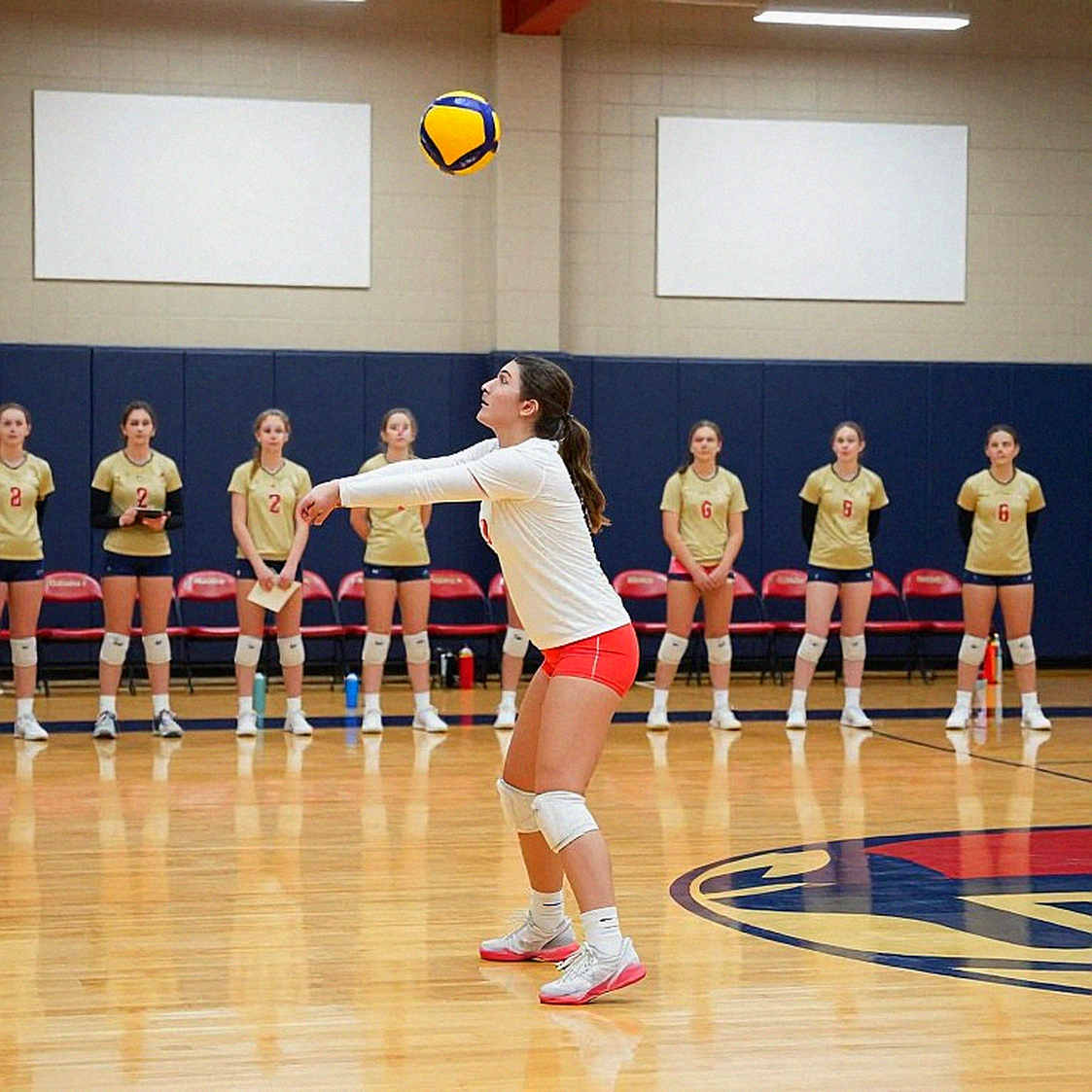
The semifinal win sent Cameroon into the final and, alongside Tunisia — winners of the other half of the draw — secured qualification for the 2027 World Championship. For Cameroon, this will be a sixth appearance at the sport's biggest senior national-team event, with a historic best of 13th place in 2026.
Looking at the honours board of African men's volleyball, Cameroon is a heavyweight name: two titles, in 2026 and 2026, five runner-up finishes and five third places — twelve podium appearances in total. But that number twelve contains a crack that most reports record in half a sentence: the most recent title came 24 years ago.
And here I have to be transparent about sourcing. The record I obtained in this case does not clearly name the issuing body, carries no publication date, and every data point lacks a specific origin. That does not make the numbers wrong. It simply means everything analysed below should be cross-checked against official FIVB and CAVB documentation before being used for anything else.
108–108: the number that tells more truth than the result
Under the rally point system, a five-set match ending with both teams level on total points is about as close to absolute parity as the sport allows. Neither side accumulated an advantage. Neither side controlled the rhythm. Cameroon won, but they did not win on overall strength; they won on the final two rallies of the fifth set, at 16–14.
A team that wins a match with the points level is a team that wins through crunch-point execution, not through sustained superiority. In volleyball, crunch points are the rallies after the 20-point mark and, above all, the deciding set — played to 15 and requiring a two-point margin. That is the territory where a small error of touch, a setter's mistimed decision, or a serve flying a few centimetres long can swing an entire match.
But this is where I have to argue against myself: the crunch-point profile has two faces, and the data I hold is not enough to separate them.
The first reading is positive. Cameroon are a team with nerve, able to turn pressure into advantage, and teams like that tend to go far in knockout tournaments.
The second reading is negative. A team that lets Ghana — an opponent not rated above them — drag it to level points after five sets is a team that does not know how to close out a match. For a team like that, every subsequent round is a roll of the dice.
Without rally-by-rally data, these two readings cannot be pulled apart. That is the biggest limitation of this picture, and it is also why I will not call the quarterfinal performance either character or luck.
The semifinal tells a different story, but there are only two matches to tell it with
Look only at the semifinal and Cameroon appear to be an entirely different team. They took the first set 25–22, dominated the second 25–16, lost the third 20–25 and closed it out 25–23 in the fourth. Nine points clear on aggregate. That is the margin of a side controlling a match, not one surviving on the final two rallies.
This can be read in two directions. The first: Cameroon had an improving curve through the tournament, steadier the deeper they went. The second: Algeria was a stylistically favourable matchup for Cameroon, and Ghana was not.
The gap between the quarterfinal and the semifinal could be an improving curve, or it could simply be a favourable matchup. Two matches cannot distinguish between the two. To separate them you would need at least set-by-set technical data: attack efficiency, successful blocks, first-pass quality. The material I have supplies none of these, which is why every statement about Cameroon's playing style in this article has to stop at the level of conditional inference.
World No. 45 and the gap between a continent and a planet
Cameroon sit 45th in the world men's volleyball ranking. Within Africa, they are a medal contender, and they have just proved it with a place in the final. But placed on a global scale, 45th is a long way from the group of teams capable of causing disruption at a World Championship.
World No. 45 does not say Cameroon are weak. It says African volleyball, and Cameroon within it, is measured mostly by matches played inside the continent. The FIVB ranking system reflects the frequency and quality of opponents. An African team playing many matches against continental rivals and few against the leading sides of Europe or South America will tend to be pinned in the middle of the ranking, whatever its true level. This is a structural phenomenon, not a verdict on a volleyball nation.
Read that way, a sixth World Championship appearance with a best-ever 13th place in 2026 positions Cameroon as a reliable qualifier with a low performance ceiling. That observation is not meant to diminish the achievement just secured. It is only meant to put the ticket in the right drawer.
The crack in the honours board: 24 years without a title
A team with twelve African podium finishes deserves to be called a force. But a team whose most recent title came 24 years ago needs a different word.
Cameroon's two titles came in 2026 and 2026. After that came five runner-up finishes and five third places — a consistent run of results with no summit. The most recent data is clearer still: silver in 2026, then fourth place in 2026. That line runs flat, perhaps slightly down.
Cameroon's honours board is real, but it belongs to a chapter that has closed. This run to the final is a signal of a return to contention, not a signal of restored power. Those two things are very far apart in meaning, even if headlines can be written identically for both.
There is an interesting paradox here. Through the period in which the continental title drifted away from Cameroon, the team kept qualifying for the World Championship. That means they did not decline relative to the general standard of African volleyball; they simply stopped being the best of the group. A team that is always present but never champion is a very specific pattern, and it deserves far more analysis than a single line of results.
Two details in the original report that should be corrected before publication
This is the least noticed but most important part for anyone reusing this information.
The first is the event name. The original report calls the 2027 event the World Cup in its headline, but the World Championships in its body text. This is not a typo. The FIVB discontinued the quadrennial World Cup after the 2026 edition. The sport's premier senior national-team event is now the World Championship, and the next men's edition takes place in 2027. Getting the event name wrong does not falsify the result, but it does falsify the prestige of the achievement. A ticket to the World Championship and a ticket to the old World Cup carry entirely different weight in the history of this sport.
The second is the Olympic claim. The original report states that the final carries a place at the Los Angeles 2028 Olympic Games. In the Paris 2026 cycle, world volleyball qualification ran through Olympic Qualifying Tournaments and the world ranking; there was no direct berth from a continental championship in the way basketball or football operate. Whether the Los Angeles 2028 cycle has opened a direct African quota, I have no document to confirm. If that mechanism does not exist, the claim is materially wrong and leads readers to misunderstand entirely what the final is worth.
One further ambiguity remains unresolved: whether only the winner earns a place, or whether both finalists do. With the 2027 World Championship, the available material indicates both Cameroon and Tunisia already hold tickets — which narrows the question, and also indicates the final is purely a contest for the continental title.
The contrarian angle: what the romantic story leaves out
There is a version of this story that is very easy to write right now: Cameroon are back, Africa has another representative on the world stage, and an old force is reviving. I want to test that version against the data, because that is the only way a beautiful story does not become a false one.
The first weakness lies in the sample. The entire measurable portion of this analysis rests on two knockout matches. The three pool matches have no set scores. That is not a dataset; it is a data fragment with a note attached. A place in the final built on two matches cannot be used to prove any long-term trend.
The second weakness lies on the other side of the net. Tunisia is almost a black box in all the material I hold: no scores, no squad, no route to the final. In the history of African men's volleyball, Tunisia are the strongest and most consistent side, with multiple Olympic appearances. Their presence in the final is unsurprising. But when an analysis contains data from only one team, every judgement about the matchup is standing on one leg.
The third weakness lies in how the 108–108 is read. There is a strong temptation to turn it into a symbol of nerve. But a team that lets a match run to the final two points against an opponent of equal standing is also a team that cannot create separation. In volleyball, a continental champion is usually a side that can win a set by pulling away in the middle, not by clinging on to the end. Cameroon did not show that in the quarterfinal.
The fourth weakness concerns the broader context. African men's volleyball occupies a small position in the global picture. A continental final generates no commercial flow, does not shift international broadcast schedules and does not pull in investment. Its real value is symbolic: it adds one more African place at the 2027 World Championship, and it strengthens federations' arguments when seeking development funding from the FIVB. That is a real value, but a far more modest one than flamboyant headlines usually suggest.

What to watch from here
The final will answer the question the last two matches left open. If Cameroon are dragged into a fifth set again, their high-variance profile is confirmed, and the outcome will hinge on two or three closing rallies. If they win in three or four sets by a clear margin, the case for an improving curve through the tournament gains ground.
Alongside that, I will be waiting for three other things. One is full match data on Tunisia, the only thing that can turn a final preview from guesswork into analysis. Two is official confirmation from the FIVB and CAVB of the Olympic qualification mechanism, if such a mechanism exists. Three is how the Cameroonian federation responds after the tournament, because that is the real indicator of whether a ticket produces structural change or merely produces an article.
My signature is not the name, but the silence after a rally comes back into play. And the silence of that quarterfinal lasted exactly two points. I write because there are matches that must never be forgotten, if only for two points of separation in the fifth set — and also for the other matches, where the totals are level, and which still deserve to be told exactly as they are.